Accessible Travel in Coburg: Inclusive Leisure Ideas
Accessible Travel in Coburg: Inclusive Leisure Ideas (Outlook on Upcoming Offers)
Anyone who wants to experience Coburg in a relaxed way – with a wheelchair, walker, stroller, or with the desire for well-planned routes – pays attention above all to one thing: reliable information and as few surprises as possible along the way. In Coburg and the Coburg region, several steps are planned in the near future to make leisure, culture, and mobility more inclusive.
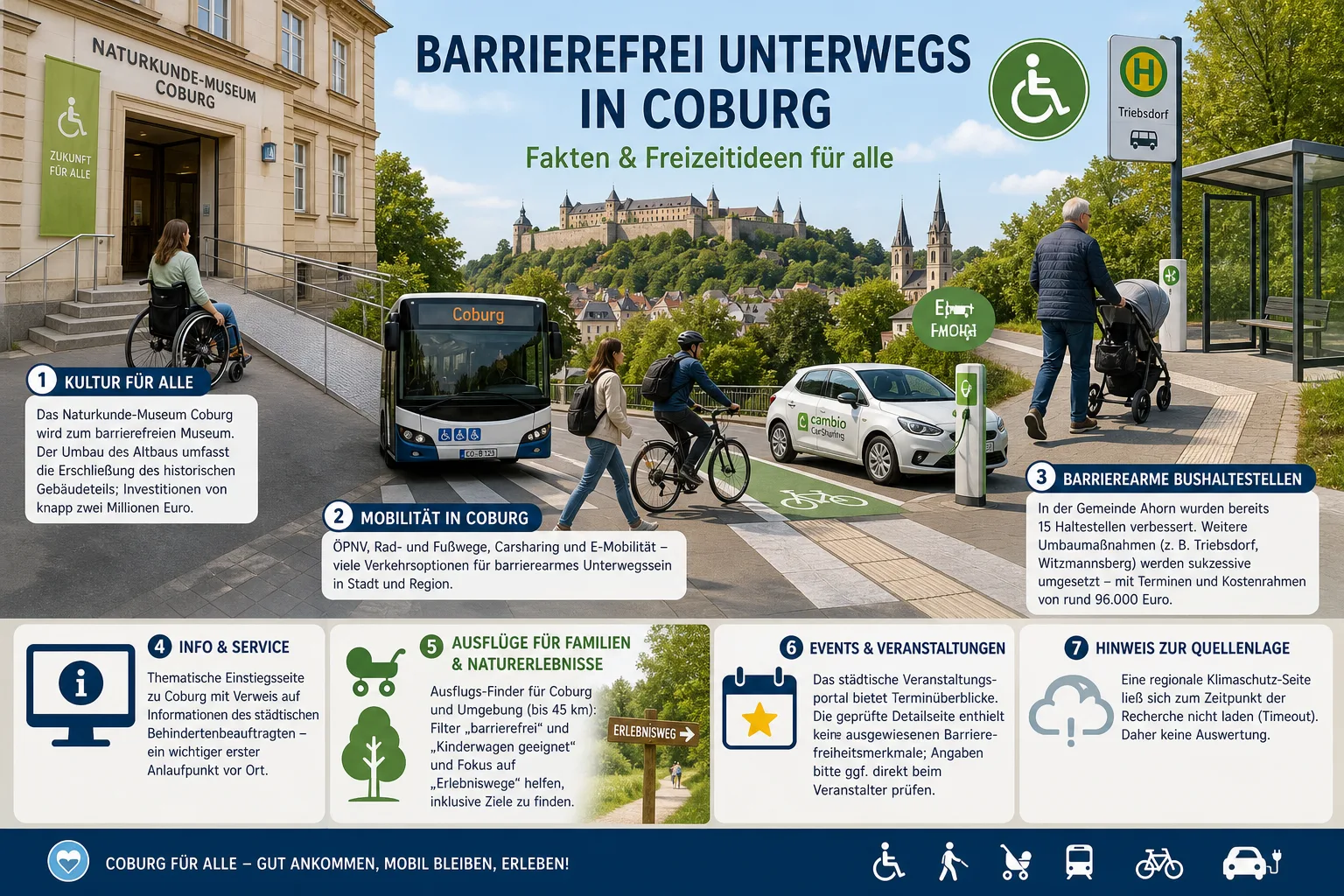
2) Culture for All: Accessibility at the Natural History Museum (planned/ongoing)
A central building block for inclusive leisure in Coburg is the further development of cultural institutions. For the Natural History Museum, a gradual improvement of accessibility is being pursued. The focus is typically on:
- better accessible routes within the building (clearer, wider, fewer bottlenecks),
- vertical access (e.g., elevator solutions where structurally possible and sensible),
- more accessible information offerings (more legible labeling, comprehensible texts; depending on the concept, also audio/digital solutions).
A multi-million investment framework is planned for these measures. The goal is that museum visits will more often succeed without additional organization in the future – for example, for people with mobility impairments, families with strollers, or groups who rely on well-structured routes.
Note for planning: Since structural implementations often take place in stages, it is worth checking the current notices from the museum or the city before visiting (e.g., regarding access, elevators, temporary detours, or individual closed areas).
3) Mobility Region Coburg: Arrive Better, Change More Easily
For accessible leisure offers to really be reachable, there needs to be an interplay of local transport, path networks, and supplementary mobility offers. In the Mobility Region Coburg, offers are to be more closely networked in the coming years – with the aim of making routes in the city and surrounding area simpler and more reliable.
What This Can Mean for More Accessible Leisure Routes
- More comfort in public transport: more accessible stops, understandable passenger information, and as smooth as possible transfers.
- Better "last meters" quality: easily usable sidewalks, safe crossings, and comprehensible route guidance to leisure locations.
- Additions to the classic bus & train chain: where available, car sharing or e-mobility offers can fill a gap (e.g., for excursion destinations outside dense public transport schedules).
Especially for excursions, it is crucial that information about access, detours, and alternative routes is easy to find. The better this works, the more spontaneously people can organize their leisure time.
4) Accessible Stops in the Surrounding Area: The Next Expansion Step
Accessibility does not end at the city limits. In the Coburg region, further redesigns of bus stops are also planned to make boarding and alighting easier in the future. Such measures often include – depending on location and street space:
- higher or adapted curbs for the most step-free entry possible,
- better lighting and clear waiting areas,
- high-contrast information and easily recognizable edges,
- tactile elements, if provided, for better orientation.
For leisure, this means concretely: Those who live in the surrounding area should be able to reach Coburg more easily – for example, for a museum visit, a stroll through the city, or meetings. Conversely, excursions from Coburg to the surrounding area become more attractive when stops are more comfortable and safer to use.
Important: During construction phases, stop locations, platforms, or routes may change at short notice. For a less stressful journey, it is recommended to check the current traffic information from the responsible transport company or association in advance.
5) Planning Aids: Making Excursions More Accessible to Plan
The best reconstruction is of little use if information is hard to find. For more accessible leisure planning, two things will be especially important in the future:
- Central contact points (city websites, tourism portals, disability commissioners): They bundle information about access, accessible routes, contact persons, and services.
- Search and filter functions in excursion portals: Filters such as "accessible" or "stroller-friendly" can help narrow down destinations more quickly – especially if route length, surface, or inclines are also described.
If you are planning a trip to Coburg, it is best to use a short checklist:
- Is the access step-free or are there alternative accesses?
- Are there accessible toilets and how can they be reached?
- What is the route from public transport like (crossings, inclines, surface)?
- Are there contact options for queries (phone/email) and current notices?
6) Outlook: Coburg as a More Inclusive Leisure City
Coburg can become noticeably more inclusive in the coming years if three developments work together: (1) more accessible cultural venues, (2) public transport with better accessible stops, and (3) transparent, easily accessible information. Then "accessible travel" will become less of an exception and more of a norm – for locals as well as for guests.
To ensure that expectations and reality match, one point remains particularly important: up-to-dateness. Construction measures, detours, and the status of offers change. If you want to plan safely, you should check the current notices from the responsible offices shortly before the excursion.