Citizens' Assemblies in Coburg: Experience City Politics
Citizens' Assemblies in Coburg 2026/2027: How You Will Be Heard at Upcoming Dates
A future-oriented guide: What will happen at the next citizens' assemblies in Coburg, how to register, how to formulate your concern as a motion, and how it will proceed in the city council and administration afterwards.
What the Next Citizens' Assemblies Will Be About
At the upcoming citizens' assemblies in Coburg, the city administration and residents will come together in a public forum to discuss current and upcoming municipal topics. The focus will typically be on issues affecting everyday life and the long-term development of Coburg, such as:
- Mobility and traffic (e.g. traffic safety, parking, cycling and pedestrian traffic)
- Urban planning and construction (e.g. usage concepts, neighborhood development, housing)
- Education, care, and youth (e.g. school routes, play and recreational areas)
- Order, safety, and prevention (e.g. lighting, conflict points in public spaces)
- Cleanliness, noise, green and recreational quality (e.g. waste, noise hotspots, maintenance of facilities)
The key point is: At the next assemblies, you will not only be able to "air" your concern, but present it in a way that will then be further processed in municipal committees.
Legal Basis: Why the Next Citizens' Assemblies Will Take Place
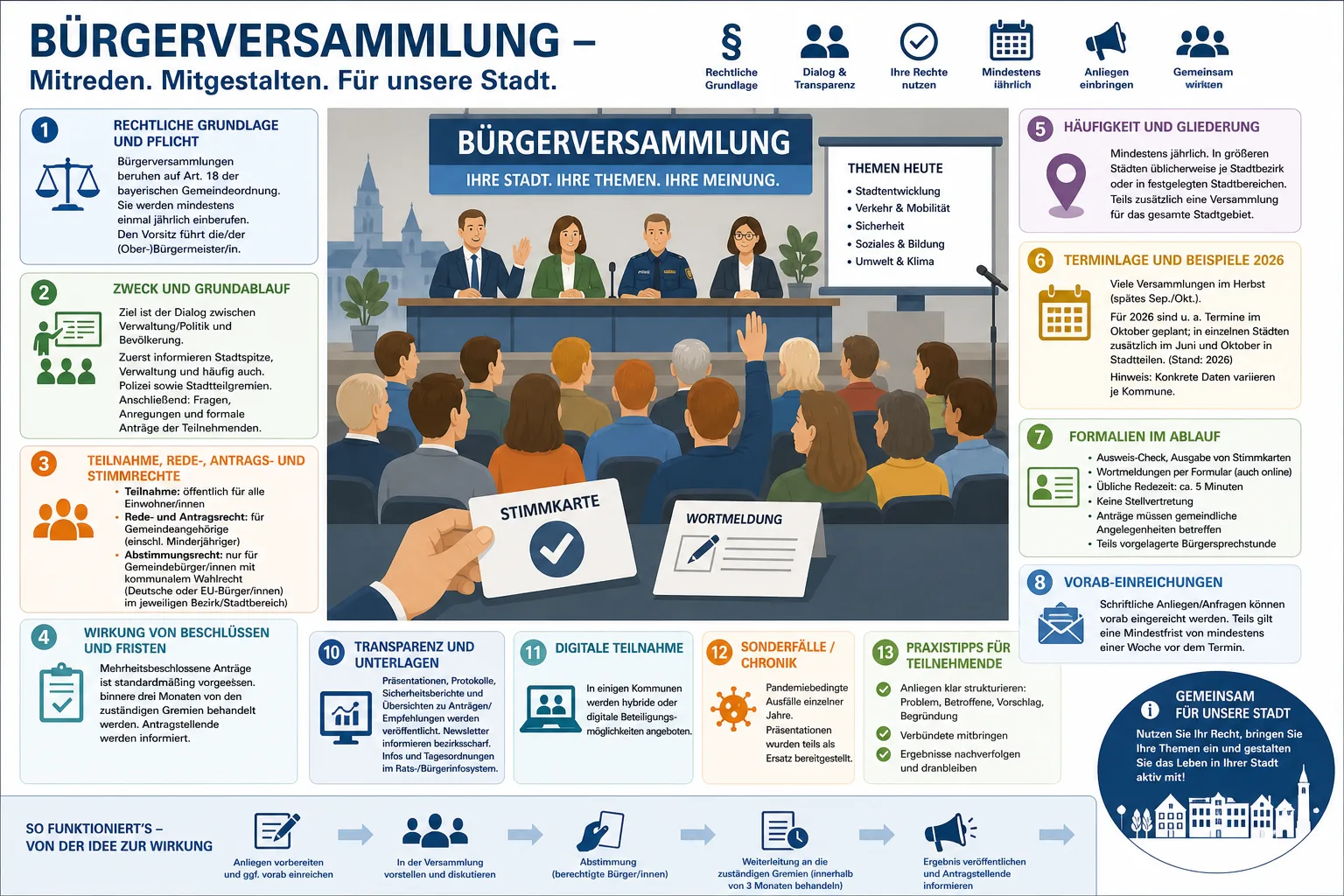
The holding of citizens' assemblies is regulated in Bavaria by the municipal code. For Coburg, this creates the basis that the city must convene at least one citizens' assembly per year. The (Lord) Mayor will chair; the event will be public and enable discussion of municipal matters.
For you, this means: The next dates will not be "optional" in the political calendar, but will be based on a clear legal obligation and a defined participation format.
What the Typical Procedure Will Look Like at Upcoming Dates
If you attend one of the next citizens' assemblies, you will usually experience a process that enables transparency and exchange in sequence:
- Opening and formal framework: Notes on speaking order, submitting motions, and voting.
- Report from the city leadership/administration: An overview of upcoming projects, plans, and developments in the respective area or citywide.
- Information contributions (depending on the date): Departments or security actors will explain topics such as traffic, prevention, or construction projects.
- Discussion: Questions, comments, criticism, and suggestions from the audience.
- Motions and, if applicable, votes: Formal concerns will be submitted as motions and put to a vote during the assembly, provided the requirements are met.
- Conclusion and outlook: Notes on what will happen after the assembly (minutes, processing in committees).
To make effective use of the evening, it will be worthwhile to use the information block as a basis and then formulate your concern clearly, briefly, and with reference to responsibilities.
Who Will Be Allowed to Participate – and Who Will Be Allowed to Speak, Submit Motions, and Vote?
The next citizens' assemblies will be designed as a low-threshold participation opportunity. In practice, three levels will be important:
- Participation (listening/informing): The assembly will be public; residents will be able to attend.
- Right to speak and submit motions: Anyone considered a member of the municipality (resident in Coburg) will be able to present their concern during the discussion and submit it as a motion; this will also include minors.
- Right to vote: In votes, usually only municipal citizens with local voting rights will be entitled to vote. Organizational checks (e.g. ID/voting card) will take place at the entrance.
If you plan to vote or submit a motion yourself, you should therefore have your identification documents ready and pay attention to the instructions in the invitation.
Submitting a Motion at the Next Citizens' Assemblies: How Your Concern Becomes "Actionable"
For your concern to be treated as a motion at an upcoming citizens' assembly, it must follow two basic rules:
- Responsibility: The topic must be a matter for the City of Coburg (i.e. something the city administration or city council can decide or manage).
- Specificity: The motion must contain a clear measure (not just a general dissatisfaction).
A Proven Structure That Will Work for Future Contributions
- Location & Situation: Where does the problem occur (street/section/square) and when?
- Impact: Who is affected (children, seniors, residents, businesses) and how?
- Proposal: What exactly is being requested (e.g. marking, changed signage, crossing aid, lighting, maintenance interval)?
- Justification: Why will the measure improve the situation (safety, noise reduction, quality of stay, accessibility)?
If you bring supporters from your environment, this will increase the visibility of your concern. At the same time, a factual tone and adherence to speaking time will ensure your message comes across clearly.
What Will Happen After a Motion Is Accepted: Processing, Deadlines, and Follow-Up
If your motion is accepted by a majority at an upcoming citizens' assembly, it will generally become a recommendation to the responsible municipal committees. This means:
- The recommendation will carry political weight, even if it does not directly replace an administrative act.
- The responsible bodies will process the motion within the period provided for in the municipal code.
- Subsequently, you will be able to track via minutes and council/citizen information systems when the topic will be on the agenda and what decision or statement will be made.
For follow-up, it will be worthwhile to check the publication of minutes/overviews of the citizens' assembly after the date and to observe the subsequent discussion in committees or the city council.
Accessibility and Digital Participation: What You Should Plan for Upcoming Dates
To enable as many people as possible to use the next citizens' assemblies, accessibility and supportive services will play a central role. If you need assistance, it will be sensible to pay attention early to the contact options in the invitation (e.g. for seating needs, hearing support, or language mediation).
Additionally, digital information channels (such as publication of documents, notices, or results) will make your preparation easier. If hybrid or digital participation options are offered, these will typically be announced in the invitation or on the city's information pages.
Your Preparation for the Next Citizens' Assemblies: Checklist
- Read the invitation: Date, place, start, admission rules, speaking and motion modalities.
- Check the topic: Does your concern fall under the city's responsibility?
- Gather evidence: Photos, short notes on times/observations, possibly a signature list (if appropriate).
- Formulate the motion briefly: A clear measure in one sentence plus justification.
- Plan your appearance: 1–2 minutes introduction, then motion, then justification; focus on what is feasible.
- Plan follow-up: Check the minutes, follow further discussion in committees, ask follow-up questions if necessary.
Why Attending the Upcoming Dates Will Be Worthwhile
If you attend a citizens' assembly in Coburg in the coming months, you will experience city politics where it becomes immediate: in direct exchange between the population, administration, and municipal leadership. For you, this will bring three concrete advantages:
- Early influence: You will be able to give input before decisions are "finalized."
- Public clarification: You will receive answers in a transparent, public setting.
- Structured forwarding: Your concern can be forwarded as a recommendation into the responsible processes.
This way, a single statement becomes the chance for a transparent municipal processing procedure – and you will help shape your city's development in the truest sense of the word.