Further Education in Coburg: Career Opportunities & Funding
Further Education in Coburg: Inspiration for Mind & Career
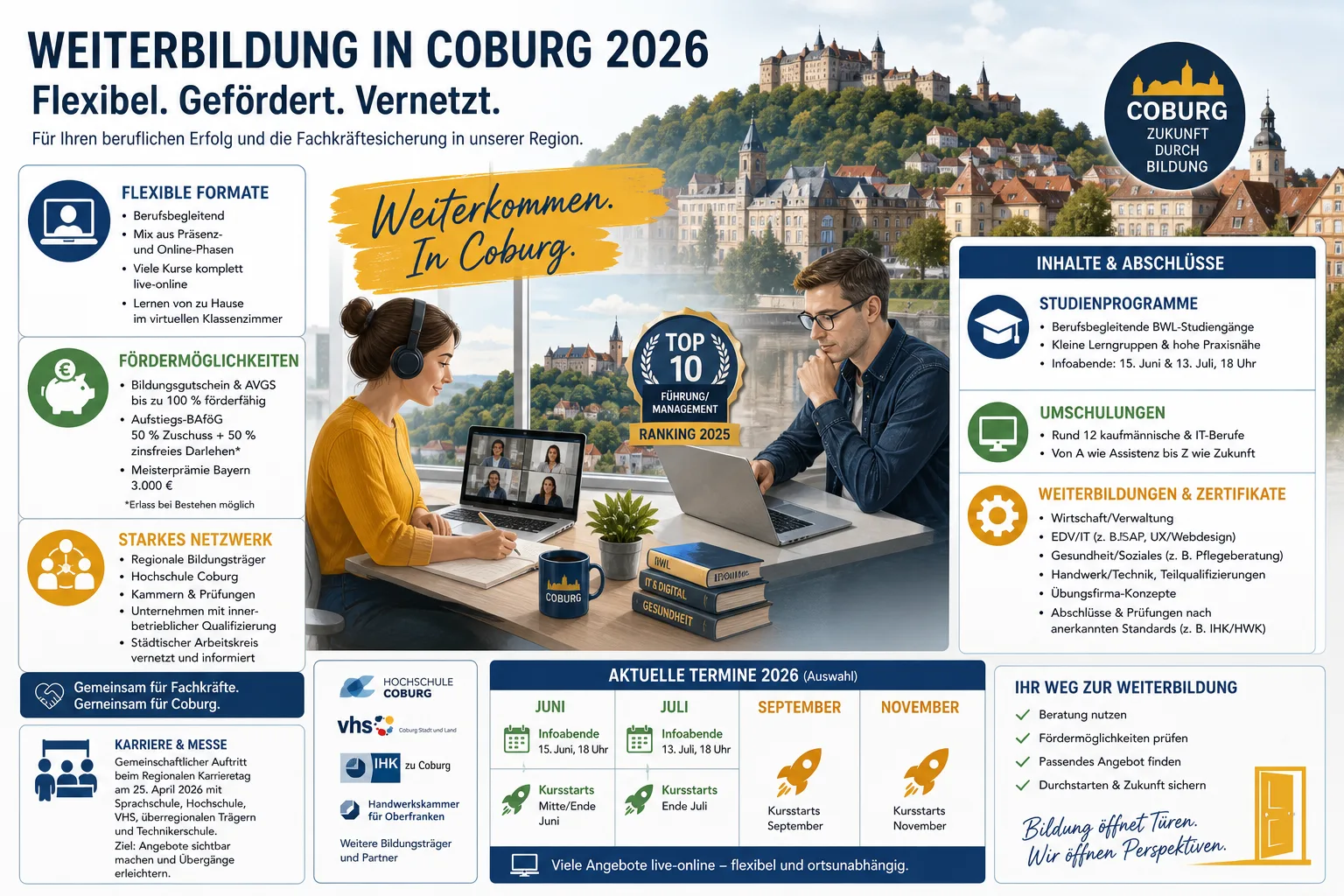
Anyone planning their next professional step in Coburg today will find more paths than ever before: part-time courses, live online classes, retraining, and advanced training programs. In addition, there are funding programs that – depending on your personal situation – can cover a large part of the costs. This overview shows which formats are typically available, how to prepare your decision in a structured way, and where to find reliable information on funding and requirements.
Further Education in Coburg: City, Network, Opportunity
Coburg, as an educational and economic location in Upper Franconia, is characterized by a mix of medium-sized companies, crafts, services, and a university landscape. This creates a broad further education ecosystem: chambers, universities, private education providers, and public institutions cover both academic qualifications and practical professional degrees.
For you as a participant, this has a concrete advantage: instead of "one size fits all," there are paths that fit your life reality and goals – from short certificate courses to modular partial qualifications to multi-year advanced training programs.
Formats: part-time, live-online, and flexible
Many further education programs are now designed to remain realistic alongside work and family. Typical models, which are also common in Coburg and the region, include:
- Live online classes (virtual classroom): fixed class times with instructors, group interaction, often with supplementary learning platforms.
- Blended learning: a mix of in-person sessions (e.g., block days) and online/self-study phases.
- Part-time study programs: plannable time slots, often with modular exams and study support.
- Practice-oriented in-person formats: useful when equipment, lab, or practice situations are central (e.g., technology, certain health and counseling contexts).
Practical Tip: How to check if a format suits you
- Weekly plan test: Enter study times and class dates in your calendar for 4 weeks.
- Technical check: stable internet connection, headset, quiet room (especially important for live online).
- Support services: Ask about tutorials, office hours, review sessions, and exam preparation.
- Absence rules: Clarify how absences can be made up (e.g., recordings, substitute dates).
Content, Retraining, and Qualifications: from Business Administration to IT Certificate
The range of topics in Coburg and the surrounding area is typically broad and oriented towards regional labor market needs as well as nationally recognized professional profiles. Common fields include:
- Business & Administration: Accounting, HR, controlling, project management, organization.
- IT & digital skills: Office and collaboration tools, IT basics, system and user knowledge.
- Web/UX & digital design: user-centered conception, basics of design and implementation of digital interfaces.
- Health & Social: depending on the provider, e.g., counseling skills, communication, documentation, and process understanding.
- Crafts & Technology: adaptation qualifications, specializations, preparation for advanced training programs.
Retraining or further education – which fits which goal?
Retraining usually aims for a full professional qualification in a recognized apprenticeship occupation (with examination before the relevant authority). This is particularly relevant if you want to switch to a new professional field.
Further education (e.g., certificate courses) is suitable if you want to supplement skills, specialize, or take on responsibility more quickly in your current career.
How to recognize quality
- Transparent curriculum: clear learning objectives, number of hours, exam format.
- Recognition: Degree/certificate is clearly described (e.g., chamber exam, institute-specific certificate).
- Labor market relevance: practical components, projects, realistic exercises (e.g., case studies, practice processes).
- Eligibility for funding: if necessary, clarify whether a measure is approved for certain funding instruments.
Funding: Education Voucher, AVGS, and Advancement BAföG
Financing is the decisive point for many. In Germany, three funding paths are particularly common, which – depending on your personal situation – may be relevant:
1) Education Voucher (Employment Agency/Job Center)
The education voucher can cover the costs of suitable further education or retraining. Whether and to what extent funding is provided depends on the individual situation (e.g., professional background, integration opportunities, measure objective). The responsible bodies are the Employment Agency or Job Center, depending on the case.
2) AVGS (Activation and Placement Voucher)
The AVGS is often used for coaching, orientation, placement or shorter activation measures – for example, to stabilize the application process or as a preparatory step before longer qualification. Here too: approval and appropriate scope are individual decisions.
3) Advancement BAföG (training to become a master craftsman/specialist, etc.)
The Advancement BAföG supports training that prepares for a career advancement (e.g., master craftsman, specialist, or comparable qualifications). It combines grants and – depending on the situation – loan components. Details (funding amount, conditions, application process) are described in the official program.
Bavaria: Master Craftsman Bonus
Additionally, in Bavaria, a master craftsman bonus or a corresponding bonus may be provided for certain passed advanced training exams. Whether you are eligible depends on the applicable guidelines and your specific exam.
Practical guide: How to proceed in Coburg in a structured way
- Clarify your goal: Career change (retraining) or skill development (further education)?
- Select a measure: Content, duration, format, qualification, time commitment.
- Arrange a counseling appointment: at the Employment Agency/Job Center (for education voucher/AVGS) or at the relevant offices for Advancement BAföG.
- Prepare documents: CV, certificates, course description, cost and time plan, justification of the goal.
- Create commitment: Start date, study times, family/professional coordination, if necessary, discussion with employer.
Important: Funding decisions are always individual. For details, rely exclusively on the official bodies and the written funding conditions.
Orientation in Coburg: How to find suitable offers
To turn "I should continue my education" into a solid plan, a clear research and decision-making routine helps. In Coburg, three contact points are typically useful:
- Counseling centers (Employment Agency/Job Center): when funding, career reorientation, or retraining are relevant.
- Chambers and responsible bodies: especially for advanced training exams and recognized qualifications.
- Universities and education providers: for specific study and course offers, admission requirements, information events, and time models.
Many providers rely on regularly announced information evenings (online or on site). Such dates are suitable for clarifying questions without committing immediately: content, exam formats, workload, technical requirements, and eligibility for funding.
How further education in Coburg can shape lives and the region in the future
Further education often has a quiet effect – but a long-term one. For individuals, it can mean the step into a new job, more responsibility, or better job security. For the region, qualification strengthens the chance that open positions are filled by people who already live locally and want to stay.
If you want to start in Coburg, one thing is especially worthwhile: planning the next 30 days concretely – with a counseling appointment, an information evening, and a realistic time calculation. This turns a good intention into a project that actually begins.