How Coburg Is Changing – Discover New Cultural Venues
How Coburg Will Change – New Cultural Venues and Ideas
An outlook on projects and strategies that are set to shape Coburg's cultural and urban space in the coming years: from the freight yard area to new meeting places and open-air formats.
Note: This article describes only planned and expected developments (preview) and may change due to decisions, construction progress, or funding commitments.
From Slaughterhouse Area to Creative Quarter: What Is to Be Created
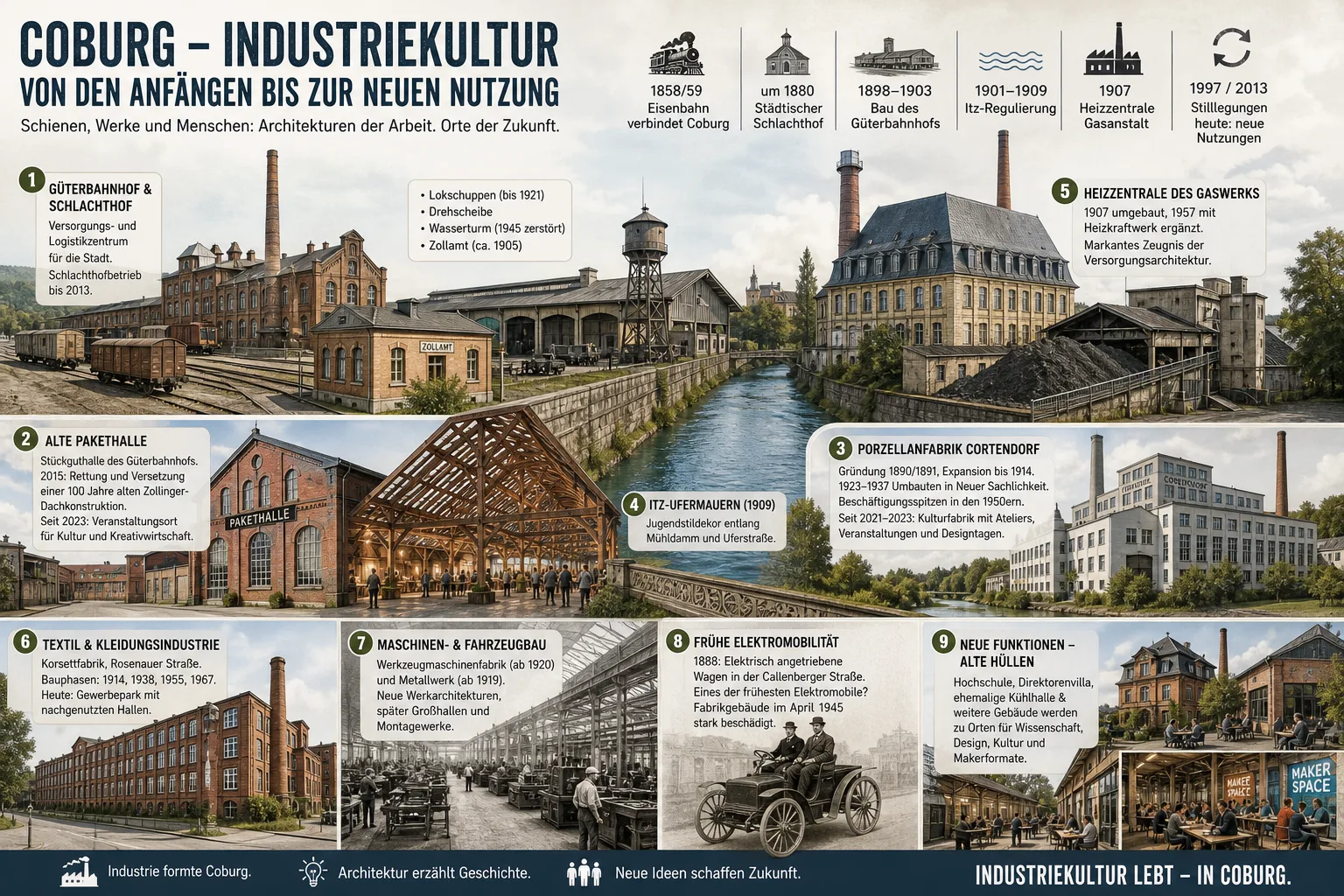
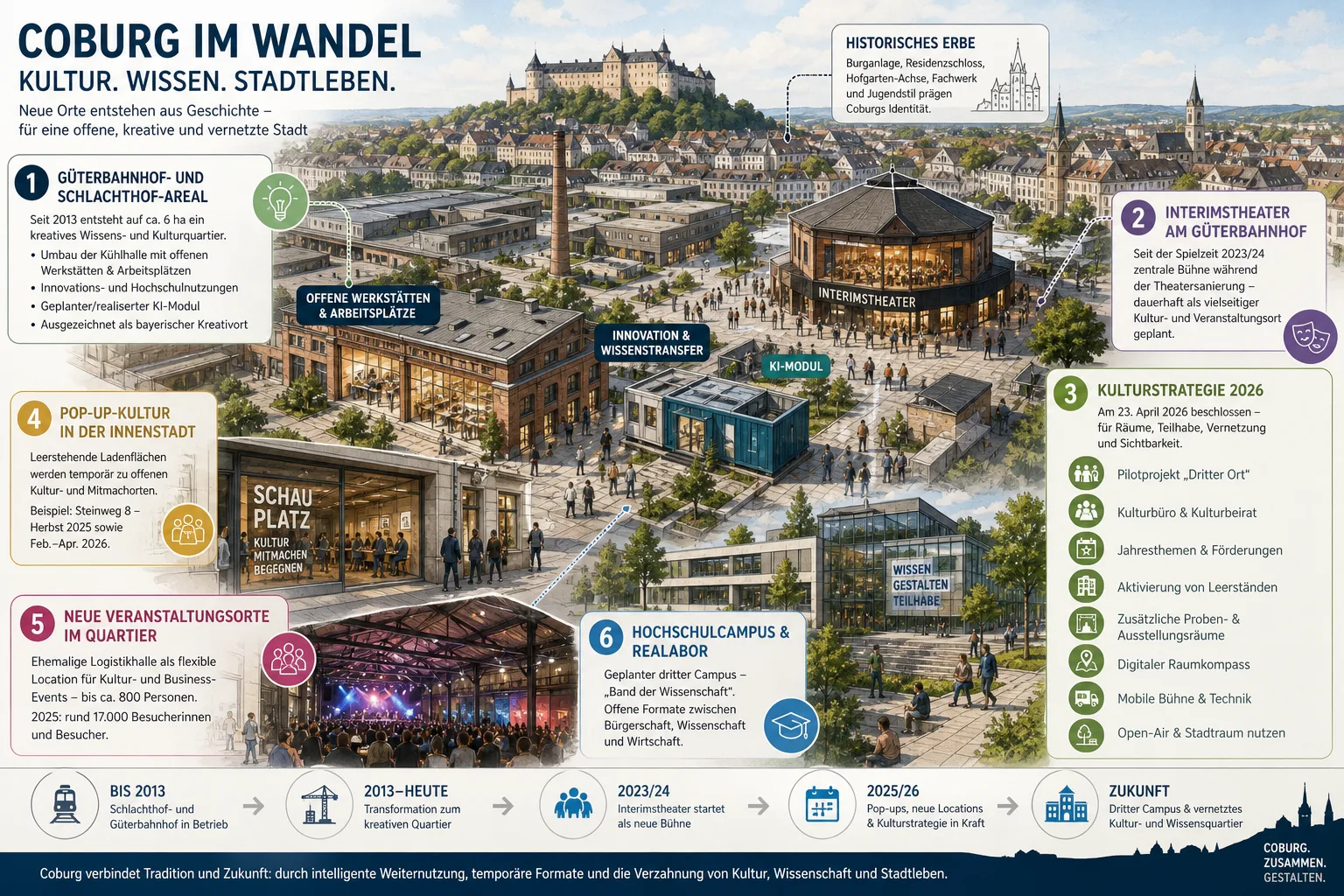
In the south of Coburg's city center, an urban development area is set to further take shape in the coming years, where culture, work, education, and urban life are more closely interlinked. The focus is on a formerly industrial area centered around former rail and logistics uses. The goal is not only to preserve existing buildings, but to repurpose them so that new, publicly visible cultural venues emerge.
It is planned that halls and robust industrial architecture will in future serve as workshops, studios, project spaces and flexible event areas. Such places will not function like classic cultural centers with a fixed program logic, but as “open infrastructure”: usable for initiatives, collaborations with educational institutions, small festivals, exhibitions, or formats that only develop in the process.
This will allow visitors to experience an additional urban space that differs from the image of a pure residence and monument city: less representative, but more experimental – and precisely for that reason a complement to the Veste, Hofgarten, and city center.
- Expected added value: more space for production and presentation (art, design, cultural work).
- Urban development: reuse instead of demolition – with visible history in the building fabric.
- Economy & work: better conditions for start-ups, cooperation, and creative services.
Interim Theater at the Freight Yard: Role and Perspective
A striking element of the coming cultural years is likely to be the continued use of a modern theater building in the freight yard area. Even though “interim” sounds transitional, such a place can in practice develop its own identity: as a stage for drama, musical theater, discussion, educational formats, and guest performances.
For Coburg, this would shift a cultural focus more strongly towards an area that is already in transition. This has a societal effect: culture is not only consumed “in the center,” but visibly linked to urban development – a path that is particularly convincing when routes (walking/cycling/public transport) and quality of stay are considered.
What will be crucial in the coming years is that the place does not remain just a venue, but that program and environment interact: collaborations with independent scenes, educational partners and neighborhoods, formats for first-time visitors, and low-threshold offerings around rehearsals, introductions, or audience discussions.
Coburg Cultural Strategy: Priorities for the Coming Years
So that individual projects do not remain isolated, a framework is needed that clarifies responsibilities, priorities, and participation. For Coburg, a continued cultural strategy is likely to start right here: It can define which spaces are needed, how participation succeeds, how actors are networked, and how visibility is created.
1) Spaces: From Single Buildings to Usable Infrastructure
Instead of relying only on a few large cultural buildings, a “space logic” is to be developed in the future: rehearsal rooms, pop-up spaces, temporary stages, and smaller exhibition venues that can be used at short notice. A transparent overview of available spaces, including usage conditions, is helpful here.
2) Participation: Everyday Places as Cultural Venues
A central tool can be the “third place” principle: a place between home and work, open, with little pressure to consume, and a changing program. If Coburg establishes such places, culture becomes part of everyday life – especially for people who do not specifically plan an evening event.
3) Networking: Advice, Cooperation, and Fair Procedures
For the coming years, it is crucial that cultural workers, administration, educational institutions, and civil society have reliable interfaces: advice on permits and funding logic, clear tendering processes, cross-sector cooperation, and recurring exchange formats.
4) Visibility: City, Squares, and Itz as a Stage
Coburg's public spaces offer a strong backdrop: squares, parks, axes between the old town and the Veste, and paths along the Itz. In the future, open-air formats, temporary installations, or city walks could bring the cultural offering more strongly into urban space – with the advantage that spontaneous encounters also become possible.
Temporary Places: Pop-up Culture as a Tool Against Vacancy
Vacant ground floor spaces are a risk to the quality of stay in many cities. For Coburg, a targeted pop-up strategy could become an important building block in the coming years: short-term usable spaces for exhibitions, readings, workshops, makerspace days, or meeting formats.
The advantage: such uses can be implemented quickly and test what actually works in the neighborhood. If the concept works, it can lead to either a longer interim use or a new permanent use. In this way, urban renewal is not only thought of structurally, but as a question of programmatic revitalization.
Success factors for pop-up culture are very concrete: transparent rental and operating cost models, simple application procedures, clear rules on safety and liability, and a calendar that shows when which door is open.
Living Labs & “Science Belt”: How Knowledge Is to Become More Visible
Another strand of the expected change lies in the closer integration of city and knowledge: living labs, public lecture series, project weeks, and collaborations between universities, businesses, and cultural actors can bring research from the seminar room into the city.
If Coburg further strengthens the idea of a “science belt” in the coming years, ideally not only additional spaces will emerge, but also new formats: citizen labs, design & build projects, exhibitions on current technology topics, or joint events where students, craftspeople, SMEs, and the urban community work together.
Practical examples of possible living lab formats in Coburg (preview):
- public prototype exhibitions with feedback stations
- neighborhood workshops on mobility, climate resilience, or accessibility
- “Science & Culture Nights” in hall and workshop environments
Between Castle and Brick: What Can Sustain the Change
Coburg's strength lies in its coexistence: monumental and small-scale, historical and industrial, representative and close to everyday life. So that new cultural venues do not seem like a break, it will be crucial in the coming years to create legibility – that is, to show how the new places fit into the city's history and what public function they fulfill.
This is especially successful when repurposing does not hide its past, but uses it as a quality: materials, ceiling heights, traces of previous use. In this way, “urban history” is not only conveyed in the museum, but in the way places are used and experienced in the future.
If this approach works, a simple, convincing narrative for the coming years emerges: Coburg continues to develop by reactivating existing spaces – and uses culture as an engine that brings people together, opens paths, and makes ideas visible.
The most exciting urban changes are often those you feel on foot: on new paths, open doors, and places where you can stay without fear of barriers.
Sources
- City of Coburg – Official Website — Information on the city, administration, and projects (retrieved on 2026-11-04)
- Bayern.de – Official State Portal — Background on state programs and funding logic (retrieved on 2026-11-04)
- Federal Ministry of the Interior and Community (BMI) — Basics and framework on urban development/urban renewal (retrieved on 2026-11-04)
- German UNESCO Commission — Context on culture, participation, and cultural diversity (retrieved on 2026-11-04)