Discover Industrial Culture & Architecture in Coburg
Industrial Culture & Architecture in Coburg: Upcoming Experiences, Guided Tours, and Event Formats
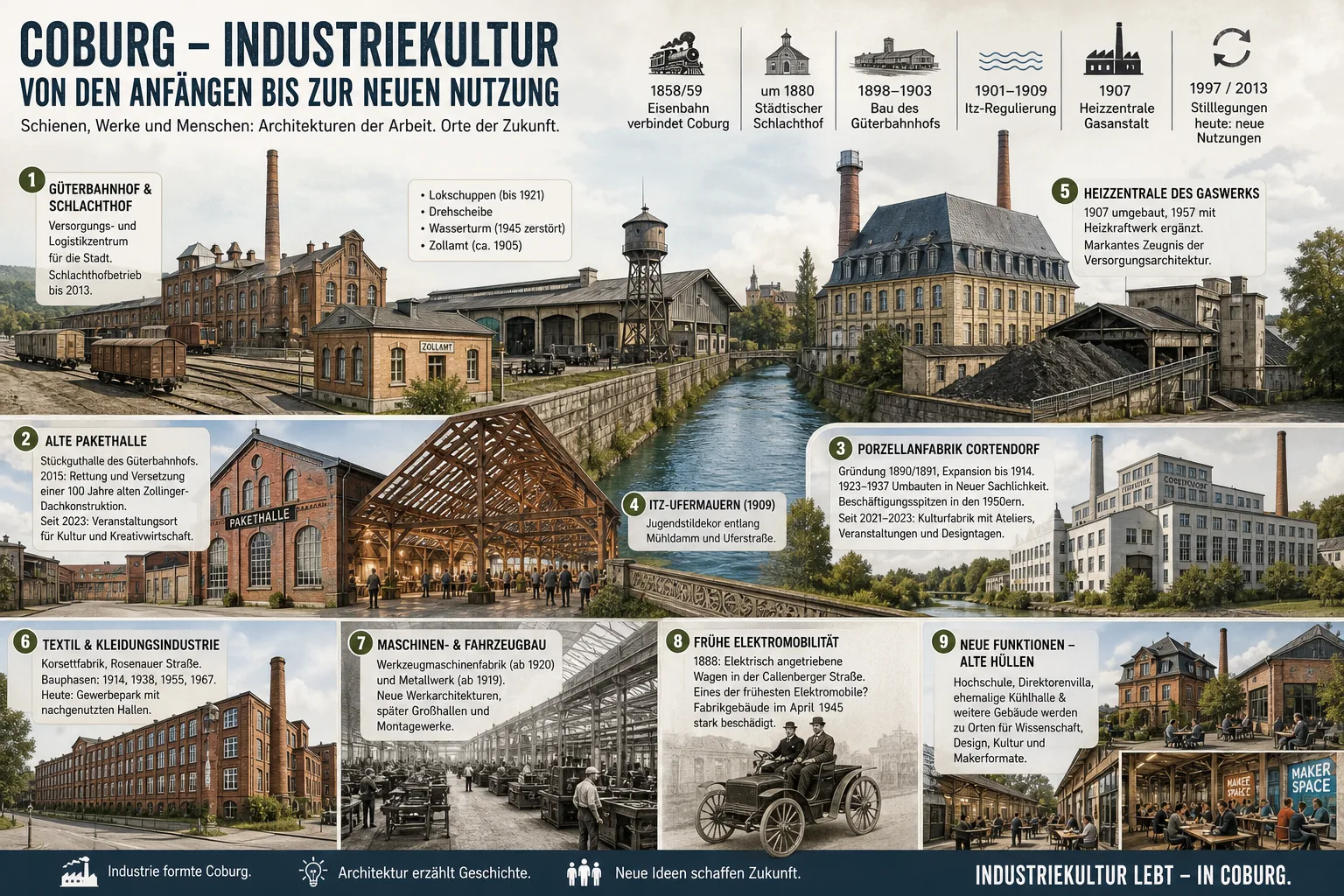
Coburg can be experienced not only as a residential city but also as a city of repurposing: places where people once worked, stored, and produced are increasingly becoming stages for design, urban development, education, and culture. This article exclusively compiles forward-looking visitor ideas: which formats typically take place at industrially influenced sites, how you can plan your next trip, and what to look out for at heritage-protected locations.
Typical Formats Around Industrial Culture in Coburg
1) Guided Walks: Learning to Read Architecture
Future tours on industrial culture are often designed as thematic walks: less "as many stops as possible," more "understand one theme." Pay attention to whether there are focal points in the announcement, such as:
- Transport & Logistics (e.g., railway environments and adjacent functional buildings)
- Energy & Utilities (e.g., technical ensembles, proximity to rivers, infrastructure architecture)
- Production Architecture (halls, workshops, administrative buildings)
- Repurposing (how robust structures become new public places)
If you want more depth: Choose tours that explicitly address heritage protection, material science, or conversion processes (instead of just "photo spots").
2) Design, Maker, and University Formats in Industrial Spaces
In Coburg, formats that combine design, technology, and the public are likely to appear regularly in the future: exhibitions, open workshops, prototyping workshops, or short lectures. Such events are especially suitable if you want to experience industrial culture not just as a visitor, but as a working environment.
Tip for your calendar: Look out for terms like "exhibition," "open studio," "open lab," "design exhibition," "maker," "festival," or "pop-up."
3) Evening Events: Light, Sound, Temporary Installations
Large, tall spaces and clear supporting structures are suitable for temporary installations (light, projection, sound). If you plan to attend such events in the future, check the announcement for:
- Entry/exit rules and capacities (industrial buildings often have strict safety regulations)
- Barrier-free access (ramp, elevator, level paths)
- Notes on temperature (halls can cool down significantly in the evening)
What to Look for in Industrial Architecture in the Future
To make your next visit to Coburg more than just a "beautiful backdrop," it is worth taking a look at features that are particularly meaningful in industrial buildings:
- Supporting Structure: Wood, steel, or reinforced concrete tell a lot about the construction period, spans, and engineering ideas of the time.
- Lighting: Ribbon windows, skylights, and sawtooth roofs were designed for even working light.
- Layers of Use: Extensions, closed gates, subsequent openings, or new stairwells show phases of conversion.
- Material Honesty: Exposed brickwork, patina, and signs of use are often part of the concept for heritage-appropriate repurposing.
- Outdoor Space: Pathways, forecourts, and riverbanks are often newly opened and made publicly accessible during revitalizations.
If you plan to take photos: The most exciting motifs are often found where old and new are visibly connected (e.g., new walkways, new railings, new installations in old structures) – not where everything looks "like new."
Planning: How to Reliably Find Upcoming Dates
For exclusively future-oriented, reliable information, official calendars and organizer websites are best suited. Use the following approach for your planning:
- Check city & tourism: Search the official event calendar using filters such as "culture," "exhibition," "guided tour," "city tour," "design."
- Check cultural institutions/locations directly: Many dates are first published on the respective venues' websites (including ticket link, entry, accessibility info).
- Monitor university & creative scene: Exhibitions and short formats are often announced by semester or project.
- Book only for confirmed dates: Plan travel, accommodation, and tickets only after official confirmation if possible.
- Date/time and end time (industrial sites often have fixed slot times)
- Ticket/registration (especially for guided tours)
- Accessibility (access, toilets, seating)
- Arrival (public transport/on foot/bike) and weather plan
- Notes on photo/video (for exhibitions/installations)
Visit Sustainably & Respectfully
Industrial culture sites are often sensitive: heritage protection, new interim uses, safety regulations, and neighborhood interests are intertwined. To ensure that future events remain possible, simple rules help:
- Only enter accessible areas: Restricted zones usually serve heritage or personal protection.
- Be considerate of residents: Especially at evening events, leave quietly.
- Prefer public transport or walking if the event info recommends it (parking may be limited).
- Plan for weather and temperature: Hall climate can differ greatly from outside conditions.
Note: This article is an editorial guide to future visitor and event formats and does not replace current safety or house rules of the respective locations.
Sources & Further Links
- UNESCO Intangible Cultural Heritage (official portal) — Context on cultural heritage and its communication (accessed 2026-10-14)
- ICOMOS (International Council on Monuments and Sites) — Basics on heritage conservation/heritage and international guidelines (accessed 2026-10-14)
- Bavarian State Office for Monument Protection (BLfD) — Information on heritage protection and procedures in Bavaria (accessed 2026-10-14)
- German Foundation for Monument Protection — Classification, practical examples, and terms related to heritage protection (accessed 2026-10-14)
- City of Coburg (official portal) — Entry point for official information and references to municipal offers/dates (accessed 2026-10-14)