
Hugo Harrer
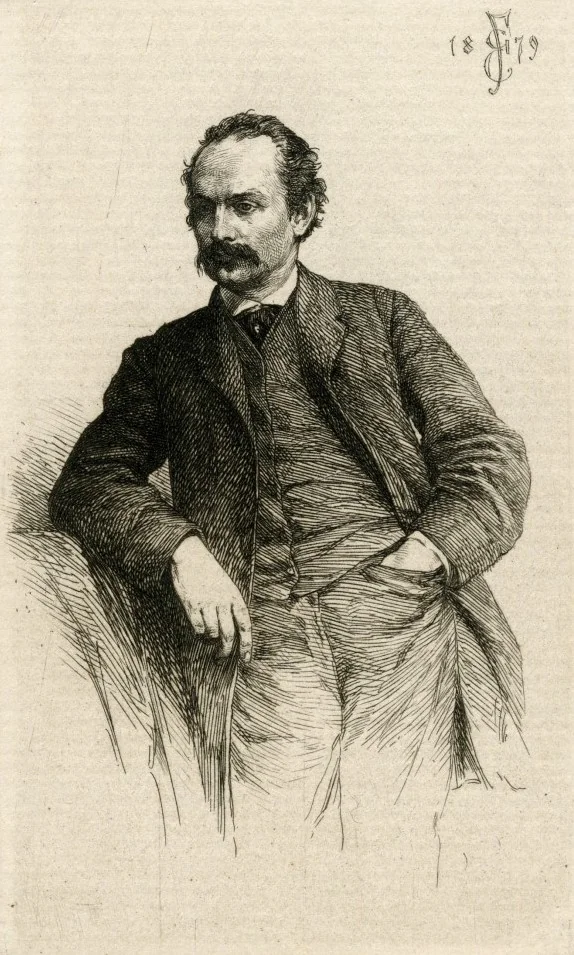
Image from Wikipedia
Image from Wikipedia
Hugo Harrer – Landscape and Architectural Painting of the Düsseldorf School
A Quiet Realist Between Nuremberg, Munich, Düsseldorf, and Rome
Hugo Paul Harrer, born on February 6, 1836, in Eberswalde and died on December 10, 1876, in Rome, is considered one of the German landscape and architectural painters of the Düsseldorf School. His artistic journey leads from an initial architectural education to self-taught painting characterized by precise nature observation, a realistic perspective, and the allure of historical urban landscapes. It is this combination of architectural accuracy and atmospheric narrative power that makes Harrer an intriguing figure in 19th-century German art. (de.wikipedia.org)
Biography: From Aspiring Architect to Independent Painter
After starting his architectural training, Harrer soon turned to painting and developed further as a self-taught artist. Influential were private studies in the studios of friends and careful observation of nature; he never permanently attended an art academy. This independent learning biography lends his work a unique authenticity, as his visual language emerged not from academic routine, but from direct observation. (de.wikipedia.org)
His first paintings were created in Nuremberg, where the picturesque architecture of the city inspired him to early attempts at architectural painting. Later, he moved to Munich to be inspired by Carl Theodor von Piloty's realistic painting style. Harrer thus navigated a historical art tension between romantic city views, realistic precision, and the emerging modern vision. (de.wikipedia.org)
Rome as an Artistic Laboratory
In 1861 or 1862, Harrer moved to Rome for health reasons, where he joined Ludwig Passini and painted studies from nature. The Italian capital became for him not just a place of residence but a productive open-air studio. There, he sharpened his eye for street scenes, ruins, and coastal landscapes, finding motifs that permanently shaped his realistic approach. (de.wikipedia.org)
He also continued his education in Düsseldorf and studied at the art academy in Oswald Achenbach's landscape class. From 1868 to 1872, he was a member of the Malkasten artists' association before returning to Rome once again. From there, he gathered studies and sketches that served as the basis for oil paintings regularly exhibited in German art exhibitions. (de.wikipedia.org)
Work Profile: Architecture, Ruins, and Italian Coasts
Harrer's work revolves around picturesque architecture, street scenes, ruins, and Italian coastal landscapes. His paintings connect spatial order with a finely graded handling of light, making buildings not just backdrops, but carriers of historical mood. It is this mixture of topographical accuracy and poetic pictorial dramaturgy that makes his painting interesting to this day. (de.wikipedia.org)
The German Biography explicitly describes Harrer as a modern realist who wanted to present subjects as he saw them. He particularly appreciated the "picturesque corners" of decaying ruins, those interstices where architecture, transience, and atmosphere come together. In this sense, Harrer's art acts as a concentrated observation of the European urban space in the 19th century. (deutsche-biographie.de)
Selected Significant Works
Among the surviving works are Old Hanse from 1868, View of the Amalfi Coast at Sunset from 1871, and At the Theatre of Marcellus in Rome and The Theatre of Marcellus in Rome, both from 1876. Also included is the motif A Jewish Street Vendor in a Street in Siena. This selection clearly shows Harrer's deep interest in urban spaces, historical architecture, and Italian local color. (de.wikipedia.org)
Artistic Development and Stylistic Classification
Harrer represents within the Düsseldorf School a calm, detail-oriented, and atmospherically sensitive painting style. His journey from architecture student to landscape and view painter explains the special attention he paid to perspective, mass, and spatial effect. Therefore, the composition of his paintings likely depended not only on scenic allure but also on the clear readability of built forms. (de.wikipedia.org)
The painterly power of his works lies in the combination of realistic observational intent and a romantic affinity for ruins, street corners, and coastal panoramas. Harrer did not seek the grand format but rather the dense scene, the precise gaze, and the quiet tension of the place. In this lies his artistic uniqueness: he tells stories about architecture without losing sight of the landscape, and he describes landscapes without neglecting architecture. (de.wikipedia.org)
Impact, Classification, and Cultural Value
Harrer's significance lies less in spectacular life events than in the consistency of his attitude. He worked independently, closely connected to nature, and with a distinct realistic temperament that opposed mere convention. His paintings are thus valuable testimonies of an art that takes what is seen seriously and preserves the dignity of the place. (deutsche-biographie.de)
Biographically, Harrer remains interesting as his stations in Nuremberg, Munich, Düsseldorf, and Rome reveal a dense network of artistic influences. In these centers, a style formed that intertwines 19th-century German painting with Italian impressions. Anyone interested in architectural painting, realism, and the Düsseldorf School will find in Hugo Harrer a precise and underrated representative of this era. (de.wikipedia.org)
Conclusion: An Artist for Explorers
Hugo Harrer fascinates with the quiet sovereignty of his work: no loud myth, but a carefully constructed oeuvre of nature studies, urban observations, and realistic form sensitivity. His paintings offer a view of the 19th century that is simultaneously objective, poetic, and historically profound. Anyone wanting to understand the Düsseldorf School should not overlook Harrer – and experience his art in its original form, where composition, light, and architecture achieve their greatest effect. (de.wikipedia.org)
Official Channels of Hugo Harrer:
- Instagram: No official profile found
- Facebook: No official profile found
- YouTube: No official profile found
- Spotify: No official profile found
- TikTok: No official profile found