
Slime (Band)
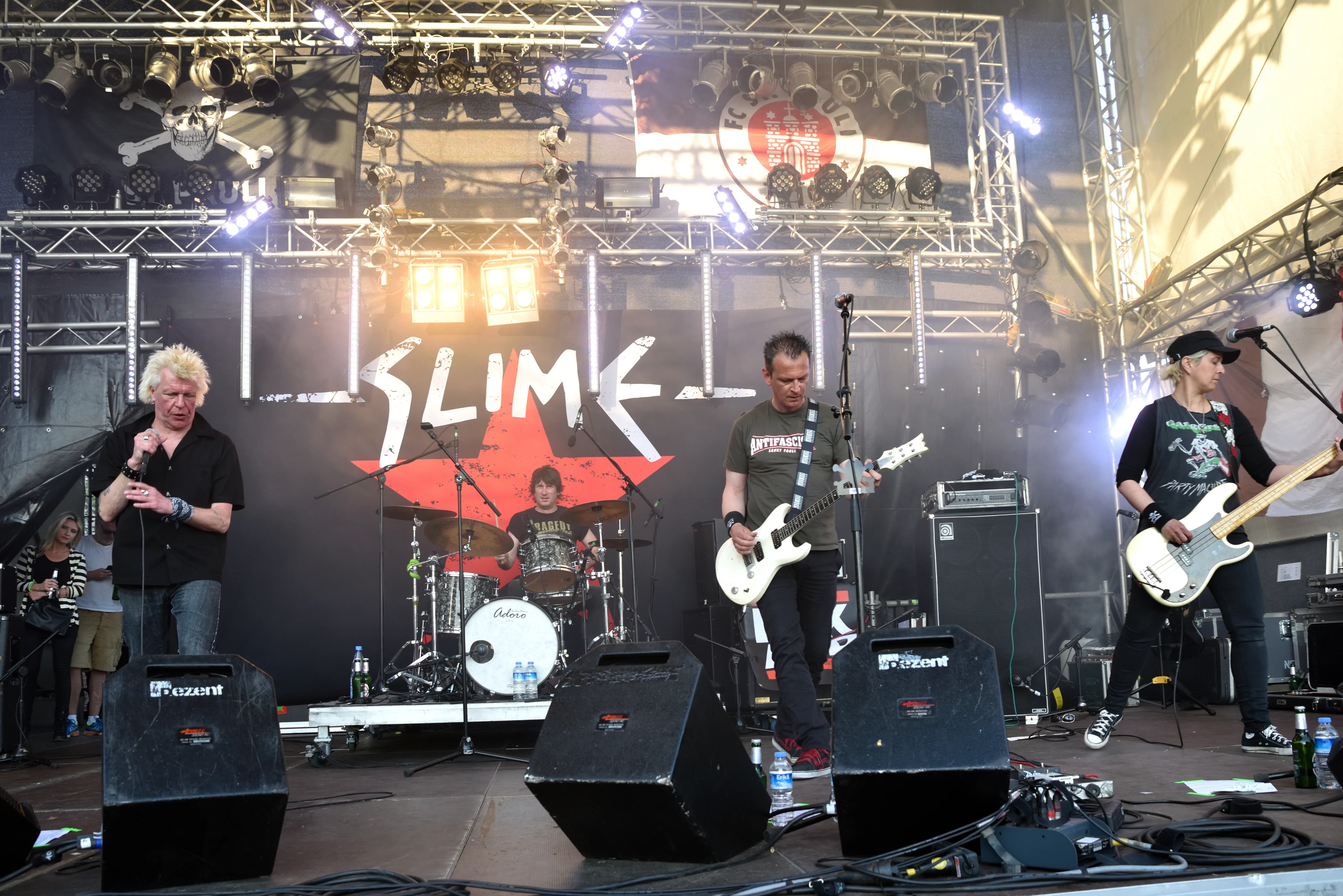
Image from Wikipedia
Image from Wikipedia
Slime – German punk from Hamburg that made history
Radical, political, vibrant: Why Slime has provided the soundtrack for dissent since 1979
Slime is a German punk band from Hamburg, founded in 1979. With uncompromising lyrics, driving rhythms, and a clear anti-fascist stance, the group shaped the DNA of Deutschpunk. Through several phases of dissolution, reunion, and personnel changes, the band evolved from raw two-minute attacks to more sophisticated compositions with dense imagery – always maintaining an irreconcilable stage presence and a musical career that has influenced generations of politicized listeners.
From the legendary early works through the 1990s renaissance to the current lineup featuring guitarist Michael “Elf” Mayer, Christian Mevs (guitar), Nici (bass), Alex Schwers (drums), and singer Tex Brasket, Slime embodies not just protest music but a cultural resonance space where punk as an attitude continues to flourish. The band combines genre history, uncompromising production, and lyrical resistance into a canon of German-language protest songs.
Early Years: From the Bunker Rehearsal Space in Hamburg to an Icon of Deutschpunk (1979–1984)
In the late 1970s, the first wave of British punk exploded in Hamburg – Slime channeled this energy into immediate, catchy statements. The early singles and the debut "Slime I" (1981) represent the raw aesthetics of that time: short, aggressive songs with striking slogans that quickly diffused into the autonomous scene. Lyrics like "We don't want no pig cops" and "Police SA/SS" faced legal challenges – an early indication of how much Slime provoked and impacted. Musically, straight-forward punk, influenced by British styles, dominated; aesthetically, the trio's signature of distorted guitar, pulsating bass, and uncompromising vocals was already unmistakable.
With "Yankees raus" (1982), the band intensified its political perspective – anti-imperialism, anti-militarism, anti-fascism – while "Alle gegen Alle" (1983) marked a stylistic development: more complex arrangements, denser storytelling, and darker chord progressions. These albums established Slime as a reference point in Deutschpunk and as a provocateur beyond scene boundaries.
Controversies, Indexing, and Protest as an Aesthetic Program
Slime polarized opinions. Accusations of "selling out" accompanied their growing popularity; anti-American lyrics faced internal leftist criticism. At the same time, legal investigations repeatedly occupied the authorities and indexing agencies. The fact that some slogans nonetheless shaped everyday culture – from stickers to graffiti – illustrates the band's cultural imprint. These tensions sharpened their profile: punk as an artistic development that does not shy away from friction but seeks it to unleash impact.
The legal disputes fueled a musical countermovement: Slime responded with more precise language and complex song structures. The production became drier, more powerful, and the arrangements gained in dynamism; rhythmic accents, tempo changes, and multi-part choruses brought the lyrics to the forefront.
Reunion and 1990s Renaissance: "Viva la Muerte" and "Schweineherbst"
After dissolving in 1984, the band returned in the early 1990s against the backdrop of xenophobic riots. The albums "Viva la Muerte" (1992) and "Schweineherbst" (1994) translated socio-political moods into dark, edgy guitar sound – less a nostalgic update than a stylistic continuation with contemporary diagnostic sharpness. The production of the 90s albums sounds raw and organic: guitar-driven, bass-centered, with straightforward drumming that puts the lyrics in focus.
This phase solidified Slime's status as chroniclers of social upheaval. Their cultural influence was evident in the growing presence in music press and scene archives – and in a fanbase that saw the comeback as a necessary corrective in the discourse of music.
The 2000s to 2010s: Revisiting History – "Sich fügen heißt lügen", "Hier und jetzt"
With their reunion in 2009, Slime opened a new chapter. "Sich fügen heißt lügen" (2012) lyrically dedicated itself to Erich Mühsam; musically, the band combined anthemic hook lines with gripping riffs. The album broke into the German charts and proved that politically charged punk can still resonate decades after the original formation. "Hier und jetzt" (2017) sharpened the analysis of the present – from the attack on right-wing populism to reflections on political violence. Compositional-wise, the band worked with a clear verse-chorus structure, breaks, and catchy choruses that generated maximum sing-along density live.
During this period, the production significantly professionalized: clearer guitar sound, present vocals, tighter low-end punch. The studio sonic refinement supports the intelligibility of the lyrics – crucial for protest music that aims to be semantically impactful.
"Wem gehört die Angst" (2020): Chart Success and Maturity
In 2020, Slime released "Wem gehört die Angst" – an album that bundled sound, attitude, and craftsmanship. The record entered the Top 10 in Germany (number 9 in the Official German Album Charts) and received strong reviews in the music press for its combination of biting lyrics and streamlined, powerful arrangement. The reception underscores the band's authority: punk as mature yet unbroken art of dissent, driven by precise production and pointed hook figures.
Songwriting features clear chorus hooks, modulated gang shouts, and rhythmic accents between downstrokes and synchronized toms. The mix makes the vocals stand front and center; guitars double in quint parallels, while the bass maintains the metric grounding.
A New Chapter with Tex Brasket: "Zwei" (2022) to "3!+7hoch1" (2025)
After the departure of Dirk "Diggen" Jora, the band found a new voice in Tex Brasket in 2021. "Zwei" (2022) showcased the updated soundscape: a powerful, raw-voiced lead that continues Slime's tradition of protest. In 2025, the 13th studio album "3!+7hoch1" followed – also the second album with Brasket. Pre-release singles like "Armes Deutschland" and "Evolution" placed the band stylistically between classic Deutschpunk energy and contemporary production, including exciting visual concepts (including analog stop-motion and AI-generated video as aesthetic counterpoints).
Live, Slime remains a high-pressure aggregate: driving drums, edgy guitar figures, collective choruses. The 2025/26 tours took the material through clubs and venues; the setlists intertwined new songs with classics – a dramaturgical arrangement that organically connects history and present.
Discography – Cornerstones that Shaped the Canon
Albums (selection): "Slime I" (1981), "Yankees raus" (1982), "Alle gegen Alle" (1983), "Viva la Muerte" (1992), "Schweineherbst" (1994), "Sich fügen heißt lügen" (2012), "Hier und jetzt" (2017), "Wem gehört die Angst" (2020), "Zwei" (2022), "3!+7hoch1" (2025). Singles like "Wir wollen keine Bullenschweine" (1980) set early markers; later singles structured the albums as cycles with clear thematic axes. The discography shows a continuous artistic evolution: from the brutal early works to the more mature, textually encoded form of protest that works with arrangement, dynamics, and production.
Chart and press reception peaked in 2020 with "Wem gehört die Angst" (Top 10), accompanied by reviews that praised Slime's lyrical sharpness, confident production, and topical relevance. The cultural-historical imprint of the early albums – particularly the politicization of punk semantics in Germany – remains unbroken.
Style, Sound, Production: What Makes Slime Distinctive
Genre-historically, Slime represents Deutschpunk with a clear edge: fast tempos, stoic downstrokes, bass lines as the backbone, compressed, articulate vocals. From the 1980s onwards, more complex song forms and narrative texts came to the fore; the band expanded pure aggression with dramatic arcs. The production features dry drums, cutting mids in the guitars, and a mix architecture that prioritizes the intelligibility of the message – a protest aesthetic design that translates directly to live performances.
Lyrically, Slime employs topoi of resistance: anti-fascism, anti-racism, anti-imperialism. Quotes, allusions, and literary references (from Erich Mühsam to political theory) anchor the songs in cultural memory. This interplay of genre competence, composition, and arrangement gives the band an authority recognized beyond scene boundaries.
Cultural Influence: Slogans, Practice, and Punk as Public Life
Hardly any German-speaking punk band has carried as many slogans into everyday life as Slime. The language of the songs migrated from concert halls to urban spaces as markers of dissent. The band thus became the soundtrack for autonomous and alternative milieus and a catalyst for a political pop culture in music history. Legal disputes, indexing, and debates over "the boundaries of art" made Slime a case study for artistic freedom.
By continuously reaching new generations – whether through reissues, documentaries, or new albums – the band remains relevant in discourse. It shows that punk is not museum-bound but is updated through production, lyrics, and stage presence. This long-lasting effect is perhaps the most important contribution to musical and cultural heritage.
Current Projects (2025–2026): New Album, New Videos, Tour
With "3!+7hoch1," Slime made a significant statement in 2025. The singles "Armes Deutschland" and "Evolution" formed thematic and visual focal points – bridging handcrafted stop-motion aesthetics and AI-generated imagery. The release was accompanied by an extensive tour that took the band through Germany, Austria, and Switzerland in 2025/26. Production, artwork, and video concepts focus on the question of how protest aesthetics must sound and look today to break through the algorithmic threshold.
At the same time, the band maintains its archive – from re-releases to curated live editions – and works on a live setup that organically integrates new pieces into the canon. The sound remains immediate, and the approach direct: Slime plays live as if it’s all on the line – and that’s precisely what it’s about.
Conclusion: Why Slime Remains Relevant
Slime combines historical significance, artistic development, and contemporary relevance. The band transforms anger into form, political analysis into choruses, and attitude into stage presence. Anyone wanting to understand how protest music works in German – compositionally, lyrically, and production-wise – will find a reference work here. The invitation is clear: experience Slime live. Because there, in the pull of the choruses and riffs, music becomes lived public life.
Official Channels of Slime:
- Instagram: No official profile found
- Facebook: https://www.facebook.com/slimepunk
- YouTube: No official profile found
- Spotify: No official profile found
- TikTok: No official profile found
Sources:
- SLIME – Official Band Homepage
- Wikipedia – Slime (Band)
- Away From Life – Slime releases "Evolution" (News, 2025)
- Away From Life – New album "3!+7(hoch1)" and release tour (2025)
- Vampster – New album "3!+7hoch1" (News, 2025)
- Metal1.info – "Armes Deutschland" (News, 2025)
- Metal1.info – "Evolution": Two videos (News, 2025)
- VISIONS – Albums of the Week (01.08.2025)
- Arising Empire via lifePR – "Wem gehört die Angst" at #9 (20.03.2020)
- Apple Music – "Wem gehört die Angst" (Album details)
- Apple Music – "Sich fügen heißt lügen" (Album details)
- Wikipedia: Image and text source