
Coburg
Rosenau 10, 96472 Rödental, Deutschland
European Museum of Modern Glass | Tickets & Images
In the Rosenau Castle Park near Coburg, the European Museum of Modern Glass combines art, craftsmanship, and material research into a unique experience: Since 2008, this branch of the Coburg Fortress Art Collections has presented the most extensive exhibition of modern glass art in Europe in a glass new building opposite the orangery. On 1,260 m², visitors can experience the development of studio glass from the 1960s to the present – from freely shaped objects to precisely sawed, ground, and annealed sculptures to large-scale installations. Thanks to its location in the romantic landscape garden and the immediate proximity to parking and gastronomy, the visit can be easily planned. The museum is considered barrier-free and offers regular themed and family tours. In the cold season, reduced opening hours apply, while special exhibitions often take place in the summer. Those who love modern art, design, and material aesthetics will find here well-founded insights, current positions, and international names – embedded in the cultural landscape of Upper Franconia.
Tickets and Admission Prices: How to Plan Your Visit
The ticket purchase is straightforward: Admission tickets can be obtained directly at the museum ticket office at Rosenau 10, 96472 Rödental. As of 2025/26, the prices are €6 for adults and €4 for seniors; children and teenagers up to 18 years pay €2 in 2025 (from 2026 they are free), and children up to six years visit the museum free of charge. For groups of 20 or more, a reduced price of €4 per person applies, and persons with disabilities also pay €4. Teachers and educators can visit the museum free of charge in a professional context. Combo tickets are sensible for culture enthusiasts: The ticket for Rosenau Castle and the Glass Museum costs €9 and is a cost-effective choice if you want to visit both on the same day. Another combo ticket includes several houses of the art collections – Coburg Fortress, Ehrenburg Castle, Natural History Museum, Rosenau Castle, and the European Museum of Modern Glass – and is valid for one year from the date of purchase; it is ideal if you want to keep your stay in the region flexible or plan to return. All price information refers to the officially published rates and facilitates travel planning without hidden costs. Since special tours and workshops may incur additional charges, it is advisable to check the schedule before your visit. Tip: Don't forget cash – many smaller museum ticket offices still operate with a classic cash system, making the ticket purchase on-site particularly quick. Families benefit from the family ticket (two adults with children up to 18 years) – it significantly reduces overall costs and makes the trip even more relaxing. In short: fair prices, clear discounts, flexible combo models – this makes glass art accessible to all.
Directions to Rosenau Rödental and Parking at the Glass Museum
The museum is located in an English landscape garden not far from the neo-Gothic Rosenau Castle – an excursion destination that combines nature, architecture, and art. For driving directions, enter “Rosenau 10, 96472 Rödental” into your GPS. Right next to the museum, there is a parking lot and a restaurant, so the journey and dining can seamlessly connect. For visitors with mobility impairments, a designated disabled parking space is available in the adjacent parking lot. Those arriving by public transport can use the city bus Rödental “Green Line 2” on weekdays. Inform the driver of your stop request “Schlosspark Rosenau/Glasmuseum” to ensure the stop is serviced. For the return trip, a call bus is available; the call should be made at least one hour in advance at 09566/1285. Additionally, line 3 (Sändleinweg – Rödental Oeslau Bahnhof) connects the location. With the combination of scheduled service and call bus, the museum is also easily accessible without a car. On-site, short distances provide orientation: The glass building is located opposite the orangery and is easily recognizable due to its transparent architecture. For travel groups, a brief phone coordination with the museum team is advisable, especially if a bus is arriving or a tour is desired. Those wishing to visit Coburg Fortress should ideally plan a separate time block – the paths between Coburg's old town, the fortress, and Rosenau are scenic but not identical, and each station deserves sufficient time. Conclusion: Whether by car, bus, or in conjunction with other destinations – the journey to Rosenau is straightforward, parking and entry into the visit are comfortably arranged.
Collection, Exhibitions, and Highlights: Europe's Most Extensive Presentation of Modern Glass Art
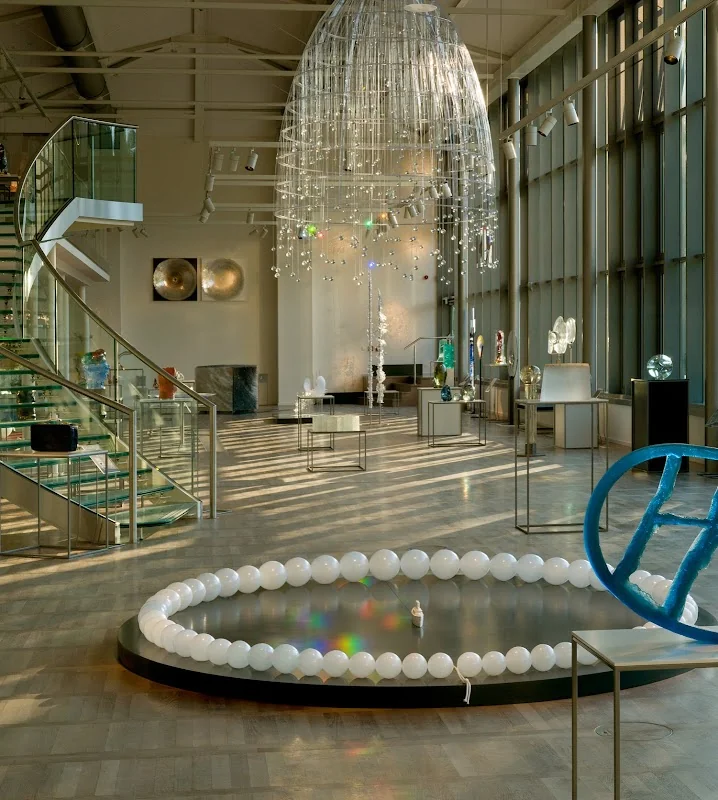
Content-wise, the museum focuses on the national and international studio glass movement, which gained momentum in the early 1960s. The permanent exhibition on the ground floor showcases key works from six decades and illustrates how artists rethink the material using hot and cold working techniques: from freely formed bubbles and massive cast bodies to sawed, ground, sandblasted, or laminated surfaces to multilayered compositions of optical glass. A central anchor is the Coburg Glass Prize: Numerous works from the competition years 1977, 1985, 2006, 2014, and 2022 exemplarily bundle the development lines – stylistically, technically, and in content. A glass staircase leads to the upper floor, where a special exhibition room and a lamp glass studio provide insights into current positions and manufacturing methods. The special exhibitions set their own accents annually; for the transition from 2025 to 2026, for example, the program “glassjam.impro” will shape the agenda. Additionally, the museum has an extensive study collection of ceramics in the basement with more than 500 exhibits from over 250 international artists – the largest presentation of modern ceramics in southern Germany. Note for visitors in winter 2025/26: Due to renovation work, the ceramic study collection is currently not accessible; this notice is communicated on the museum's website and is updated with the construction progress. The fact that the museum is now housed in a new building is due to the commitment of Coburg entrepreneur and patron Otto Waldrich; Coburg architect Albert Wagner designed the elongated, light-flooded building opposite the orangery. The result is not only a functional exhibition house but also an architectural statement that respects the park space while creating a stage for the material glass – with daylight, sight lines, and open visual relationships that intensify the experience of the objects. Together, this creates a profile that connects craftsmanship tradition, artistic research, and curatorial mediation – and in a density that is considered particularly significant in Europe.
Images and Architecture: How the “Glass House” Makes an Impression
Those looking for “Images from the European Museum of Modern Glass” will find a motif that immediately explains why architecture is part of the narrative here: The new building opens up with a wide window front to the park, creating a play of transparency, reflection, and refraction both outside and inside – ideal conditions for showcasing glass as light art. The effect varies depending on the time of day: In the early afternoon, colors, surfaces, and cuts of the exhibits stand out plastically; at dusk, the building itself glows like a lantern, making the presentation perceivable from the outside. Inside, the classic white cube elements are cleverly interwoven with sight lines, display islands, and freestanding sculpture situations. This allows for comparisons of forms and manufacturing techniques: hand-shaped hollow glass next to polished optical glass, cast bodies next to laminated layers, hot glass performances next to cold working. For image research, curated online collections are available alongside the official press and information pages, where houses, artists, and tourism partners provide image material. However, the immediate perception on-site is crucial: How color nuances shift, how edges glow in backlight, how a cast body distorts the surroundings – all this only reveals itself in the space. The exhibition dramaturgy supports this seeing: Wide sight lines allow works from different epochs to be related to each other; spotlights sharply outline textures, while diffuse surface lights make glass appear milky, velvety, or crystalline. Those working photographically will find motifs in the outdoor space (facade, park reference) as well as detailed studies of cuts, bubbles, and tool marks. In special exhibitions, the arrangement and rhythm change, providing regular visitors with new perspectives. In short: Images convey an impression – but the interplay of building, park, and collection makes the live visit irreplaceable.
Reviews, Impressions, and What Visitors Particularly Appreciate
Visitor opinions and press reviews repeatedly highlight similar qualities: the extraordinary diversity of the collection, the high-quality presentation, and the inspiring location in Rosenau Park. Families praise the illustrative mediation and the special offers for children that make the material glass playfully tangible. Art and design enthusiasts appreciate the breadth of positions – from the European “New Glass” of the late 1950s and 1960s to the American studio glass movement since 1962 to current international trends – as well as the opportunity to see techniques in context. The orientation within the museum is also positively noted: clear pathways, easily readable signage, and a service that assists with detailed questions about techniques or the careers of individual artists. Those choosing the combination of Rosenau Castle and the museum highlight the contrast between the neo-Gothic ambiance and contemporary material art as a special attraction. In the cold season, the compact opening hours play a role: Many guests consciously plan a concentrated one-and-a-half to two-hour time window that can be well combined with a walk in the park or a meal. The price-performance ratio is also frequently discussed: The moderate admission fee, combo options, and professionally curated special exhibitions are considered a strong package. From the regional perspective, the museum's integration into the network of the Coburg Fortress Art Collections is another plus: Through joint tickets and coordinated information, a cultural weekend with several houses can be planned. Those specifically looking for reviews can find current voices on common platforms – particularly helpful for practical tips on getting there, parking, or the best time to visit. The essence remains stable: high content quality, friendly service, and an environment that supports the enjoyment of art.
Opening Hours, Tours, and Accessibility: Practical Information at a Glance
Opening hours vary seasonally. For the winter period from November 11, 2025, to March 27, 2026, the museum is open Tuesday to Friday from 1:00 PM to 4:00 PM and Saturday/Sunday from 11:00 AM to 4:00 PM. In the summer months, the time windows are generally more generous; current information is continuously published online. Regular tours deepen the visit: A themed tour usually takes place once a month on a Sunday afternoon (starting at around 2:30 PM, lasting about 60 minutes), and there are also family-friendly formats. The participation fee is €5 per person plus admission. For groups, early appointment coordination is advisable. Accessibility is comprehensively considered: The building is accessible via a ramp with standard incline; inside, wide doors and barrier-free paths connect the exhibition levels. An elevator provides access to the special exhibition (upper floor) and ceramic area (basement). A barrier-free toilet is available, and wheelchairs and walkers can be borrowed on-site; lightweight folding stools are available for rest breaks. Guide dogs for the blind are allowed; specialized tours are recommended for blind and visually impaired guests. There is a designated disabled parking space in the adjacent parking lot. When planning your visit window, it is best to also consider current notices: In winter 2025/26, the museum reports renovation work in the basement, making the study collection of ceramics currently inaccessible – a good reason to focus on the glass highlights of the permanent exhibition and the respective special exhibition. With these key data – clear opening hours, reliable tour rhythms, well-managed accessibility – a smooth, inspiring museum visit is achieved.
Sources:
- European Museum of Modern Glass – Official Museum Page (Profile, Area, History)
- European Museum of Modern Glass – Admission Prices 2025/26
- European Museum of Modern Glass – Directions, Bus Lines, Call Bus
- European Museum of Modern Glass – Information on Accessibility
- Museums in Bavaria – European Museum of Modern Glass (Opening Hours, Profile)
- Homepage – European Museum of Modern Glass (Current Events, Special Exhibitions)
Show moreShow less
European Museum of Modern Glass | Tickets & Images
In the Rosenau Castle Park near Coburg, the European Museum of Modern Glass combines art, craftsmanship, and material research into a unique experience: Since 2008, this branch of the Coburg Fortress Art Collections has presented the most extensive exhibition of modern glass art in Europe in a glass new building opposite the orangery. On 1,260 m², visitors can experience the development of studio glass from the 1960s to the present – from freely shaped objects to precisely sawed, ground, and annealed sculptures to large-scale installations. Thanks to its location in the romantic landscape garden and the immediate proximity to parking and gastronomy, the visit can be easily planned. The museum is considered barrier-free and offers regular themed and family tours. In the cold season, reduced opening hours apply, while special exhibitions often take place in the summer. Those who love modern art, design, and material aesthetics will find here well-founded insights, current positions, and international names – embedded in the cultural landscape of Upper Franconia.
Tickets and Admission Prices: How to Plan Your Visit
The ticket purchase is straightforward: Admission tickets can be obtained directly at the museum ticket office at Rosenau 10, 96472 Rödental. As of 2025/26, the prices are €6 for adults and €4 for seniors; children and teenagers up to 18 years pay €2 in 2025 (from 2026 they are free), and children up to six years visit the museum free of charge. For groups of 20 or more, a reduced price of €4 per person applies, and persons with disabilities also pay €4. Teachers and educators can visit the museum free of charge in a professional context. Combo tickets are sensible for culture enthusiasts: The ticket for Rosenau Castle and the Glass Museum costs €9 and is a cost-effective choice if you want to visit both on the same day. Another combo ticket includes several houses of the art collections – Coburg Fortress, Ehrenburg Castle, Natural History Museum, Rosenau Castle, and the European Museum of Modern Glass – and is valid for one year from the date of purchase; it is ideal if you want to keep your stay in the region flexible or plan to return. All price information refers to the officially published rates and facilitates travel planning without hidden costs. Since special tours and workshops may incur additional charges, it is advisable to check the schedule before your visit. Tip: Don't forget cash – many smaller museum ticket offices still operate with a classic cash system, making the ticket purchase on-site particularly quick. Families benefit from the family ticket (two adults with children up to 18 years) – it significantly reduces overall costs and makes the trip even more relaxing. In short: fair prices, clear discounts, flexible combo models – this makes glass art accessible to all.
Directions to Rosenau Rödental and Parking at the Glass Museum
The museum is located in an English landscape garden not far from the neo-Gothic Rosenau Castle – an excursion destination that combines nature, architecture, and art. For driving directions, enter “Rosenau 10, 96472 Rödental” into your GPS. Right next to the museum, there is a parking lot and a restaurant, so the journey and dining can seamlessly connect. For visitors with mobility impairments, a designated disabled parking space is available in the adjacent parking lot. Those arriving by public transport can use the city bus Rödental “Green Line 2” on weekdays. Inform the driver of your stop request “Schlosspark Rosenau/Glasmuseum” to ensure the stop is serviced. For the return trip, a call bus is available; the call should be made at least one hour in advance at 09566/1285. Additionally, line 3 (Sändleinweg – Rödental Oeslau Bahnhof) connects the location. With the combination of scheduled service and call bus, the museum is also easily accessible without a car. On-site, short distances provide orientation: The glass building is located opposite the orangery and is easily recognizable due to its transparent architecture. For travel groups, a brief phone coordination with the museum team is advisable, especially if a bus is arriving or a tour is desired. Those wishing to visit Coburg Fortress should ideally plan a separate time block – the paths between Coburg's old town, the fortress, and Rosenau are scenic but not identical, and each station deserves sufficient time. Conclusion: Whether by car, bus, or in conjunction with other destinations – the journey to Rosenau is straightforward, parking and entry into the visit are comfortably arranged.
Collection, Exhibitions, and Highlights: Europe's Most Extensive Presentation of Modern Glass Art
Content-wise, the museum focuses on the national and international studio glass movement, which gained momentum in the early 1960s. The permanent exhibition on the ground floor showcases key works from six decades and illustrates how artists rethink the material using hot and cold working techniques: from freely formed bubbles and massive cast bodies to sawed, ground, sandblasted, or laminated surfaces to multilayered compositions of optical glass. A central anchor is the Coburg Glass Prize: Numerous works from the competition years 1977, 1985, 2006, 2014, and 2022 exemplarily bundle the development lines – stylistically, technically, and in content. A glass staircase leads to the upper floor, where a special exhibition room and a lamp glass studio provide insights into current positions and manufacturing methods. The special exhibitions set their own accents annually; for the transition from 2025 to 2026, for example, the program “glassjam.impro” will shape the agenda. Additionally, the museum has an extensive study collection of ceramics in the basement with more than 500 exhibits from over 250 international artists – the largest presentation of modern ceramics in southern Germany. Note for visitors in winter 2025/26: Due to renovation work, the ceramic study collection is currently not accessible; this notice is communicated on the museum's website and is updated with the construction progress. The fact that the museum is now housed in a new building is due to the commitment of Coburg entrepreneur and patron Otto Waldrich; Coburg architect Albert Wagner designed the elongated, light-flooded building opposite the orangery. The result is not only a functional exhibition house but also an architectural statement that respects the park space while creating a stage for the material glass – with daylight, sight lines, and open visual relationships that intensify the experience of the objects. Together, this creates a profile that connects craftsmanship tradition, artistic research, and curatorial mediation – and in a density that is considered particularly significant in Europe.
Images and Architecture: How the “Glass House” Makes an Impression
Those looking for “Images from the European Museum of Modern Glass” will find a motif that immediately explains why architecture is part of the narrative here: The new building opens up with a wide window front to the park, creating a play of transparency, reflection, and refraction both outside and inside – ideal conditions for showcasing glass as light art. The effect varies depending on the time of day: In the early afternoon, colors, surfaces, and cuts of the exhibits stand out plastically; at dusk, the building itself glows like a lantern, making the presentation perceivable from the outside. Inside, the classic white cube elements are cleverly interwoven with sight lines, display islands, and freestanding sculpture situations. This allows for comparisons of forms and manufacturing techniques: hand-shaped hollow glass next to polished optical glass, cast bodies next to laminated layers, hot glass performances next to cold working. For image research, curated online collections are available alongside the official press and information pages, where houses, artists, and tourism partners provide image material. However, the immediate perception on-site is crucial: How color nuances shift, how edges glow in backlight, how a cast body distorts the surroundings – all this only reveals itself in the space. The exhibition dramaturgy supports this seeing: Wide sight lines allow works from different epochs to be related to each other; spotlights sharply outline textures, while diffuse surface lights make glass appear milky, velvety, or crystalline. Those working photographically will find motifs in the outdoor space (facade, park reference) as well as detailed studies of cuts, bubbles, and tool marks. In special exhibitions, the arrangement and rhythm change, providing regular visitors with new perspectives. In short: Images convey an impression – but the interplay of building, park, and collection makes the live visit irreplaceable.
Reviews, Impressions, and What Visitors Particularly Appreciate
Visitor opinions and press reviews repeatedly highlight similar qualities: the extraordinary diversity of the collection, the high-quality presentation, and the inspiring location in Rosenau Park. Families praise the illustrative mediation and the special offers for children that make the material glass playfully tangible. Art and design enthusiasts appreciate the breadth of positions – from the European “New Glass” of the late 1950s and 1960s to the American studio glass movement since 1962 to current international trends – as well as the opportunity to see techniques in context. The orientation within the museum is also positively noted: clear pathways, easily readable signage, and a service that assists with detailed questions about techniques or the careers of individual artists. Those choosing the combination of Rosenau Castle and the museum highlight the contrast between the neo-Gothic ambiance and contemporary material art as a special attraction. In the cold season, the compact opening hours play a role: Many guests consciously plan a concentrated one-and-a-half to two-hour time window that can be well combined with a walk in the park or a meal. The price-performance ratio is also frequently discussed: The moderate admission fee, combo options, and professionally curated special exhibitions are considered a strong package. From the regional perspective, the museum's integration into the network of the Coburg Fortress Art Collections is another plus: Through joint tickets and coordinated information, a cultural weekend with several houses can be planned. Those specifically looking for reviews can find current voices on common platforms – particularly helpful for practical tips on getting there, parking, or the best time to visit. The essence remains stable: high content quality, friendly service, and an environment that supports the enjoyment of art.
Opening Hours, Tours, and Accessibility: Practical Information at a Glance
Opening hours vary seasonally. For the winter period from November 11, 2025, to March 27, 2026, the museum is open Tuesday to Friday from 1:00 PM to 4:00 PM and Saturday/Sunday from 11:00 AM to 4:00 PM. In the summer months, the time windows are generally more generous; current information is continuously published online. Regular tours deepen the visit: A themed tour usually takes place once a month on a Sunday afternoon (starting at around 2:30 PM, lasting about 60 minutes), and there are also family-friendly formats. The participation fee is €5 per person plus admission. For groups, early appointment coordination is advisable. Accessibility is comprehensively considered: The building is accessible via a ramp with standard incline; inside, wide doors and barrier-free paths connect the exhibition levels. An elevator provides access to the special exhibition (upper floor) and ceramic area (basement). A barrier-free toilet is available, and wheelchairs and walkers can be borrowed on-site; lightweight folding stools are available for rest breaks. Guide dogs for the blind are allowed; specialized tours are recommended for blind and visually impaired guests. There is a designated disabled parking space in the adjacent parking lot. When planning your visit window, it is best to also consider current notices: In winter 2025/26, the museum reports renovation work in the basement, making the study collection of ceramics currently inaccessible – a good reason to focus on the glass highlights of the permanent exhibition and the respective special exhibition. With these key data – clear opening hours, reliable tour rhythms, well-managed accessibility – a smooth, inspiring museum visit is achieved.
Sources:
- European Museum of Modern Glass – Official Museum Page (Profile, Area, History)
- European Museum of Modern Glass – Admission Prices 2025/26
- European Museum of Modern Glass – Directions, Bus Lines, Call Bus
- European Museum of Modern Glass – Information on Accessibility
- Museums in Bavaria – European Museum of Modern Glass (Opening Hours, Profile)
- Homepage – European Museum of Modern Glass (Current Events, Special Exhibitions)
European Museum of Modern Glass | Tickets & Images
In the Rosenau Castle Park near Coburg, the European Museum of Modern Glass combines art, craftsmanship, and material research into a unique experience: Since 2008, this branch of the Coburg Fortress Art Collections has presented the most extensive exhibition of modern glass art in Europe in a glass new building opposite the orangery. On 1,260 m², visitors can experience the development of studio glass from the 1960s to the present – from freely shaped objects to precisely sawed, ground, and annealed sculptures to large-scale installations. Thanks to its location in the romantic landscape garden and the immediate proximity to parking and gastronomy, the visit can be easily planned. The museum is considered barrier-free and offers regular themed and family tours. In the cold season, reduced opening hours apply, while special exhibitions often take place in the summer. Those who love modern art, design, and material aesthetics will find here well-founded insights, current positions, and international names – embedded in the cultural landscape of Upper Franconia.
Tickets and Admission Prices: How to Plan Your Visit
The ticket purchase is straightforward: Admission tickets can be obtained directly at the museum ticket office at Rosenau 10, 96472 Rödental. As of 2025/26, the prices are €6 for adults and €4 for seniors; children and teenagers up to 18 years pay €2 in 2025 (from 2026 they are free), and children up to six years visit the museum free of charge. For groups of 20 or more, a reduced price of €4 per person applies, and persons with disabilities also pay €4. Teachers and educators can visit the museum free of charge in a professional context. Combo tickets are sensible for culture enthusiasts: The ticket for Rosenau Castle and the Glass Museum costs €9 and is a cost-effective choice if you want to visit both on the same day. Another combo ticket includes several houses of the art collections – Coburg Fortress, Ehrenburg Castle, Natural History Museum, Rosenau Castle, and the European Museum of Modern Glass – and is valid for one year from the date of purchase; it is ideal if you want to keep your stay in the region flexible or plan to return. All price information refers to the officially published rates and facilitates travel planning without hidden costs. Since special tours and workshops may incur additional charges, it is advisable to check the schedule before your visit. Tip: Don't forget cash – many smaller museum ticket offices still operate with a classic cash system, making the ticket purchase on-site particularly quick. Families benefit from the family ticket (two adults with children up to 18 years) – it significantly reduces overall costs and makes the trip even more relaxing. In short: fair prices, clear discounts, flexible combo models – this makes glass art accessible to all.
Directions to Rosenau Rödental and Parking at the Glass Museum
The museum is located in an English landscape garden not far from the neo-Gothic Rosenau Castle – an excursion destination that combines nature, architecture, and art. For driving directions, enter “Rosenau 10, 96472 Rödental” into your GPS. Right next to the museum, there is a parking lot and a restaurant, so the journey and dining can seamlessly connect. For visitors with mobility impairments, a designated disabled parking space is available in the adjacent parking lot. Those arriving by public transport can use the city bus Rödental “Green Line 2” on weekdays. Inform the driver of your stop request “Schlosspark Rosenau/Glasmuseum” to ensure the stop is serviced. For the return trip, a call bus is available; the call should be made at least one hour in advance at 09566/1285. Additionally, line 3 (Sändleinweg – Rödental Oeslau Bahnhof) connects the location. With the combination of scheduled service and call bus, the museum is also easily accessible without a car. On-site, short distances provide orientation: The glass building is located opposite the orangery and is easily recognizable due to its transparent architecture. For travel groups, a brief phone coordination with the museum team is advisable, especially if a bus is arriving or a tour is desired. Those wishing to visit Coburg Fortress should ideally plan a separate time block – the paths between Coburg's old town, the fortress, and Rosenau are scenic but not identical, and each station deserves sufficient time. Conclusion: Whether by car, bus, or in conjunction with other destinations – the journey to Rosenau is straightforward, parking and entry into the visit are comfortably arranged.
Collection, Exhibitions, and Highlights: Europe's Most Extensive Presentation of Modern Glass Art
Content-wise, the museum focuses on the national and international studio glass movement, which gained momentum in the early 1960s. The permanent exhibition on the ground floor showcases key works from six decades and illustrates how artists rethink the material using hot and cold working techniques: from freely formed bubbles and massive cast bodies to sawed, ground, sandblasted, or laminated surfaces to multilayered compositions of optical glass. A central anchor is the Coburg Glass Prize: Numerous works from the competition years 1977, 1985, 2006, 2014, and 2022 exemplarily bundle the development lines – stylistically, technically, and in content. A glass staircase leads to the upper floor, where a special exhibition room and a lamp glass studio provide insights into current positions and manufacturing methods. The special exhibitions set their own accents annually; for the transition from 2025 to 2026, for example, the program “glassjam.impro” will shape the agenda. Additionally, the museum has an extensive study collection of ceramics in the basement with more than 500 exhibits from over 250 international artists – the largest presentation of modern ceramics in southern Germany. Note for visitors in winter 2025/26: Due to renovation work, the ceramic study collection is currently not accessible; this notice is communicated on the museum's website and is updated with the construction progress. The fact that the museum is now housed in a new building is due to the commitment of Coburg entrepreneur and patron Otto Waldrich; Coburg architect Albert Wagner designed the elongated, light-flooded building opposite the orangery. The result is not only a functional exhibition house but also an architectural statement that respects the park space while creating a stage for the material glass – with daylight, sight lines, and open visual relationships that intensify the experience of the objects. Together, this creates a profile that connects craftsmanship tradition, artistic research, and curatorial mediation – and in a density that is considered particularly significant in Europe.
Images and Architecture: How the “Glass House” Makes an Impression
Those looking for “Images from the European Museum of Modern Glass” will find a motif that immediately explains why architecture is part of the narrative here: The new building opens up with a wide window front to the park, creating a play of transparency, reflection, and refraction both outside and inside – ideal conditions for showcasing glass as light art. The effect varies depending on the time of day: In the early afternoon, colors, surfaces, and cuts of the exhibits stand out plastically; at dusk, the building itself glows like a lantern, making the presentation perceivable from the outside. Inside, the classic white cube elements are cleverly interwoven with sight lines, display islands, and freestanding sculpture situations. This allows for comparisons of forms and manufacturing techniques: hand-shaped hollow glass next to polished optical glass, cast bodies next to laminated layers, hot glass performances next to cold working. For image research, curated online collections are available alongside the official press and information pages, where houses, artists, and tourism partners provide image material. However, the immediate perception on-site is crucial: How color nuances shift, how edges glow in backlight, how a cast body distorts the surroundings – all this only reveals itself in the space. The exhibition dramaturgy supports this seeing: Wide sight lines allow works from different epochs to be related to each other; spotlights sharply outline textures, while diffuse surface lights make glass appear milky, velvety, or crystalline. Those working photographically will find motifs in the outdoor space (facade, park reference) as well as detailed studies of cuts, bubbles, and tool marks. In special exhibitions, the arrangement and rhythm change, providing regular visitors with new perspectives. In short: Images convey an impression – but the interplay of building, park, and collection makes the live visit irreplaceable.
Reviews, Impressions, and What Visitors Particularly Appreciate
Visitor opinions and press reviews repeatedly highlight similar qualities: the extraordinary diversity of the collection, the high-quality presentation, and the inspiring location in Rosenau Park. Families praise the illustrative mediation and the special offers for children that make the material glass playfully tangible. Art and design enthusiasts appreciate the breadth of positions – from the European “New Glass” of the late 1950s and 1960s to the American studio glass movement since 1962 to current international trends – as well as the opportunity to see techniques in context. The orientation within the museum is also positively noted: clear pathways, easily readable signage, and a service that assists with detailed questions about techniques or the careers of individual artists. Those choosing the combination of Rosenau Castle and the museum highlight the contrast between the neo-Gothic ambiance and contemporary material art as a special attraction. In the cold season, the compact opening hours play a role: Many guests consciously plan a concentrated one-and-a-half to two-hour time window that can be well combined with a walk in the park or a meal. The price-performance ratio is also frequently discussed: The moderate admission fee, combo options, and professionally curated special exhibitions are considered a strong package. From the regional perspective, the museum's integration into the network of the Coburg Fortress Art Collections is another plus: Through joint tickets and coordinated information, a cultural weekend with several houses can be planned. Those specifically looking for reviews can find current voices on common platforms – particularly helpful for practical tips on getting there, parking, or the best time to visit. The essence remains stable: high content quality, friendly service, and an environment that supports the enjoyment of art.
Opening Hours, Tours, and Accessibility: Practical Information at a Glance
Opening hours vary seasonally. For the winter period from November 11, 2025, to March 27, 2026, the museum is open Tuesday to Friday from 1:00 PM to 4:00 PM and Saturday/Sunday from 11:00 AM to 4:00 PM. In the summer months, the time windows are generally more generous; current information is continuously published online. Regular tours deepen the visit: A themed tour usually takes place once a month on a Sunday afternoon (starting at around 2:30 PM, lasting about 60 minutes), and there are also family-friendly formats. The participation fee is €5 per person plus admission. For groups, early appointment coordination is advisable. Accessibility is comprehensively considered: The building is accessible via a ramp with standard incline; inside, wide doors and barrier-free paths connect the exhibition levels. An elevator provides access to the special exhibition (upper floor) and ceramic area (basement). A barrier-free toilet is available, and wheelchairs and walkers can be borrowed on-site; lightweight folding stools are available for rest breaks. Guide dogs for the blind are allowed; specialized tours are recommended for blind and visually impaired guests. There is a designated disabled parking space in the adjacent parking lot. When planning your visit window, it is best to also consider current notices: In winter 2025/26, the museum reports renovation work in the basement, making the study collection of ceramics currently inaccessible – a good reason to focus on the glass highlights of the permanent exhibition and the respective special exhibition. With these key data – clear opening hours, reliable tour rhythms, well-managed accessibility – a smooth, inspiring museum visit is achieved.
Sources:
- European Museum of Modern Glass – Official Museum Page (Profile, Area, History)
- European Museum of Modern Glass – Admission Prices 2025/26
- European Museum of Modern Glass – Directions, Bus Lines, Call Bus
- European Museum of Modern Glass – Information on Accessibility
- Museums in Bavaria – European Museum of Modern Glass (Opening Hours, Profile)
- Homepage – European Museum of Modern Glass (Current Events, Special Exhibitions)
Upcoming Events
No events found
Frequently Asked Questions
Reviews
O Yefi-Ba
8. September 2025
Small but very nice museum, there are changing exhibitions. Worth a visit if you're already there for the castle.
Teresa B.
7. June 2025
Just wow. Such amazing exhibits, really impressive and unique. The names of the artworks and descriptions were also added, which is great. The staff is very nice. Parking out front, quite affordable day ticket.
Sebastian V
9. June 2025
The European Museum of Modern Glass in Rödental impresses with unique glass artworks ranging from sculptural installations to innovative design objects. Notable are works that showcase the versatility and technical finesse of the material glass. A worthwhile visit for anyone who appreciates modern art and craftsmanship.
Friedrich Lennemann
18. May 2025
Glass art is fascinating, there are many different techniques that use optical effects and enchant us. I didn't expect that at all. I arrived unsuspectingly, left inspired, and next time I want to learn and understand even more with more explanations. A small and fine collection in a beautiful park landscape, on the outskirts of Coburg, completely unexpectedly behind an ugly shopping park.
Marcus Kerneck
7. October 2025
The name suggests a large museum. However, it was quite manageable. Art is subjective, I only liked a few pieces. It's included in the combo ticket, which you can take along with Rosenau Castle. Highly recommended and just a 5-minute walk away.