
Coburg
Park, 96450 Coburg, Deutschland
Hofgarten Coburg | Events & Parking
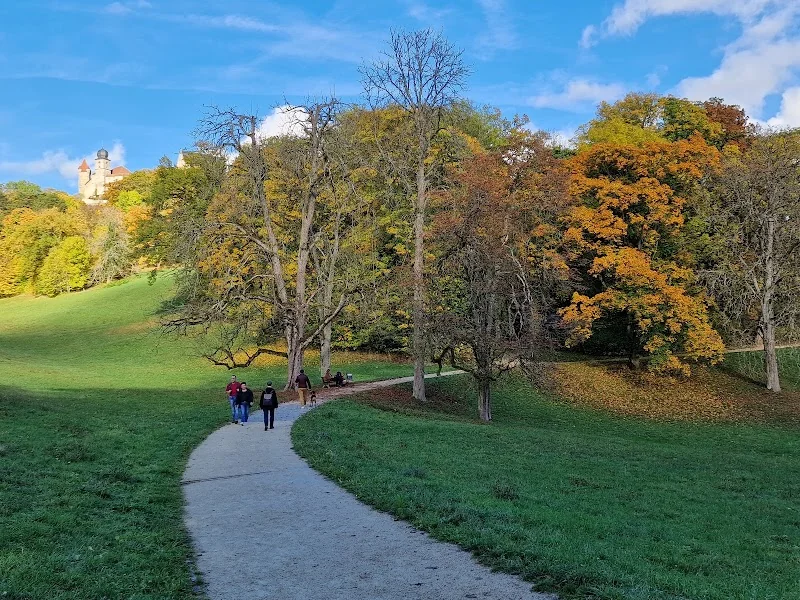
The Hofgarten Coburg is much more than just a green space between the Schlossplatz and the Veste. Walking through this landscape park, one moves through a place where city history, garden art, culture, and family life are closely intertwined. The park is about one kilometer long, covers 30 hectares, and is home to around 64 tree species from 40 genera; the oldest trees are approximately 350 years old. At the same time, the Hofgarten is a popular excursion destination with two playgrounds, a natural history museum, the pavilion of the art association, and a regular cultural program. This very mix makes it so special for Coburg: it is a recreational area, event venue, and historical ensemble all in one. Those who visit the Hofgarten experience not just a city park, but a living part of Coburg's identity that is still actively used today. ([coburg.de](https://www.coburg.de/medien/dokumente/rathaus-und-verwaltung/referate/aemter/gruenflaechenamt/co-markante-ba-ume-hofgarten.pdf))
Events and Culture in Hofgarten Coburg
The Hofgarten has developed into a stage for special moments in Coburg. Officially, it is described by the city as a place for art and culture, and especially during the Coburg Museum Night, it shows how strongly the park is integrated into cultural life. In 2026, the Museum Night will celebrate its 20th anniversary, running under the motto Night of Treasures and transforming the area around the Hofgarten between 6 PM and midnight into a lively backdrop for light, music, special exhibitions, performances, and encounters. The program includes a total of fifteen locations, including the Hofgarten itself, the natural history museum, the Veste Coburg, the Schlossplatz, and the art association. A shuttle bus service will be established between the various locations, and parking in the Anger will be offered free of charge for the evening. Thus, on this day, the Hofgarten becomes not just a passageway but the center of an entire cultural space. ([museumsnacht-coburg.de](https://www.museumsnacht-coburg.de/programm/))
In addition to the Museum Night, the permanent cultural mix also plays a significant role. In the Hofgarten, there are two fixed points of contact with the Natural History Museum Coburg and the pavilion of the art association, which shape the park throughout the year. The natural history museum, with 2300 square meters of exhibition space, is considered the largest of its kind in Northern Bavaria and makes the visit attractive even in changeable weather. The art association is one of the oldest and largest art associations in Bavaria, anchoring visual arts right in the greenery. Additionally, the Hofgarten is repeatedly used as an outdoor venue, for example, for summer festivals of the state theater or historical markets with a craft character. For visitors, this means: the Hofgarten is not a quiet museum reserve, but a place where culture actually takes place outdoors and connects with the park experience. ([coburg.de](https://www.coburg.de/coburg-erleben/natur-erholung/inhaltsseiten/hofgarten.php))
Walks between Schlossplatz, Arcades, and Veste
Those who visit the Hofgarten Coburg experience one of the most impressive landscaped urban spaces in the region. The park lies between Schlossplatz with Ehrenburg and the Arcades as well as the Veste Coburg, thus spanning a distinctive axis through the city. This location continues to shape the impact of the Hofgarten today: on one side, the view opens up to the historic residence, while on the other side, the park rises towards the fortress, conveying the special topography of Coburg. This is typical for an English landscape park, as it was further developed here in the 19th century. It is precisely the combination of wide sightlines, old tree stock, and gently curved paths that makes the walk varied. Those who walk the route calmly can not only enjoy nature but also perceive the many architectural and historical edges of the urban space. ([coburg.de](https://www.coburg.de/medien/dokumente/rathaus-und-verwaltung/referate/aemter/gruenflaechenamt/co-markante-ba-ume-hofgarten.pdf))
Particularly noteworthy is the dimension of the park: about one kilometer in length and 30 hectares in area create a space that is large enough for longer walks, but at the same time is so centrally located that it can also be spontaneously integrated into a city stroll. The official city website also emphasizes that in the Hofgarten, culture, art, and recreation merge closely together. This is exactly what makes it appealing to move away from traffic while still remaining in the heart of Coburg. The park offers not only old trees and quiet spots but also a historically dense ambiance that feels different in every season. In spring, it feels light and open, in summer shady and lively, in autumn rich in color, and in winter clear and calm. This variability is a key reason why the Hofgarten is equally popular among locals and guests. ([coburg.de](https://www.coburg.de/medien/dokumente/rathaus-und-verwaltung/referate/aemter/gruenflaechenamt/co-markante-ba-ume-hofgarten.pdf))
Access and Parking around Hofgarten Coburg
Access to the Hofgarten is straightforward because the park is located right in the center of Coburg. The city emphasizes on its parking page that Coburg is a city of short distances and that the city center remains very quickly accessible from the municipal parking garages. Mentioned are, among others, the Mauer parking garage, the Zinkenwehr parking garage, and the Post parking garage. It takes at most two minutes on foot from the Mauer parking garage to the marketplace, less than five minutes from Zinkenwehr, and at most six minutes from Post. Therefore, those heading to the Hofgarten can conveniently park in the center and walk the rest. This is especially practical because the park directly connects to the historical urban fabric of Schlossplatz and Ehrenburg, allowing visitors to easily combine their visit with a stroll through the city center. ([coburg.de](https://www.coburg.de/microsite/mobil/themen/parken/parken.php))
The official event page also helps with orientation: a map view is provided for the Hofgarten, and the journey can be planned using the Bavaria timetable. This is sensible because the park is not only a destination for walks but also a venue for events that generate additional visitor flows. Especially during larger event evenings like the Museum Night, the combination of shuttle service, central location, and urban park offerings is particularly helpful. For guests from the region, this means: the Hofgarten can be comfortably reached by both car and public transport, and the subsequent walk is short. Those planning a relaxed visit should also consider the city center parking garages, the route through Schlossplatz, and the signage in the event area. This way, the journey itself becomes part of the visit experience. ([veranstaltungen.coburg.de](https://veranstaltungen.coburg.de/details/ort/hofgarten.html))
Playgrounds, Family Outings, and Practical Tips
The Hofgarten is also a very attractive destination for families. The city describes the large playground Hofgarten Begegnung as an important neighborhood playground for the city center of Coburg. It is located above the Kleine Rosengarten, about 300 meters from the Schlossplatz, in the middle of the English landscape park and above the stairs to the Kleine Rosengarten. This location is ideal because it connects play, nature, and the city center. Children can romp here while accompanying adults simultaneously experience a true city park with historical character. For a family afternoon, this is particularly pleasant: the path is short, orientation is easy, and the park offers enough space to switch between playground, walk, and a short break. The fact that the playground is open daily also speaks for an uncomplicated visit without elaborate planning. ([coburg.de](https://www.coburg.de/boersen/spielplaetze/eintraege/Spielplatz-Hofgarten-Begegnung.php?utm_source=openai))
In the meantime, the Hofgarten has also noticeably caught up in practical matters. In 2026, the city reported that new public toilets were established at the West Pavilion, directly at the bus stop of the natural history museum. They are open Monday to Friday from 7 AM to 6 PM and on weekends from 7 AM to 5:30 PM. This is a real comfort gain for families, school classes, and all other visitors, as the Hofgarten is now better equipped not only landscape-wise but also infrastructurally. Especially during longer walks, visits with children, or event evenings, the use becomes significantly more pleasant. Together with the central park offerings and good path guidance, this shows a city park that not only looks beautiful but is also organized for everyday use. Therefore, those planning a relaxed outing will find plenty of greenery, short paths, and now also the necessary practical facilities. ([coburg.de](https://www.coburg.de/mein-coburg/artikel/2026/juli/toiletten-hofgarten.php))
History of Hofgarten Coburg
The history of the Hofgarten begins in the late 17th century. Duke Albrecht III of Sachsen-Coburg commissioned the Saalfeld architect Justinus Bieler to design a garden, and by 1682 a hillside garden in strict geometric forms was created. The layout was nearly square, and the garden thus followed the baroque or rococo understanding of order, control, and representative design. Even this origin shows that the Hofgarten was not intended as an arbitrary green space, but as a princely area with clear staging. The current location between Schlossplatz and Veste is therefore the result of a long development in which power, architecture, and garden art were thought of together from the beginning. Today, those walking through the park are moving on a historical foundation that dates back to the residence period of Coburg. ([coburg.de](https://www.coburg.de/medien/dokumente/rathaus-und-verwaltung/referate/aemter/gruenflaechenamt/co-markante-ba-ume-hofgarten.pdf))
Under Duke Ernst I, the fundamental transformation into a landscape garden in the English style began. From 1835, this change gained momentum, and in 1844 Carl Gustav Zeißig was appointed as the court gardener, who was to further develop the existing tree stock and shape the park. Under Ernst II, the Hofgarten reached its current size and shape by 1860. Already in 1857, access to the park was allowed for the public, even before its complete finishing. This opening is particularly important for the history of the Hofgarten, as it marks the transition from a princely representation space to a public city park. Thus, a residence garden became a place for all Coburg residents and guests. ([coburg.de](https://www.coburg.de/medien/dokumente/rathaus-und-verwaltung/referate/aemter/gruenflaechenamt/co-markante-ba-ume-hofgarten.pdf))
After the death of Ernst II in 1893, there were no major changes, but the Hofgarten remained a place with new signs of its time. In 1899, the bronze equestrian statue of the duke was inaugurated above the Schlossplatz, in 1903 the city had the Herzog-Alfred fountain built in the middle of the Hofgarten, and between 1912 and 1914, the natural history museum was created, which was expanded again in 1996. These later layers show how the Hofgarten has condensed over decades into an ensemble of park, monument, museum, and cultural site. This also explains why the Hofgarten today not only functions as a walking park but also as a historically charged urban space with multiple levels of use. It is precisely this continuity that makes its special charm. ([coburg.de](https://www.coburg.de/coburg-erleben/natur-erholung/inhaltsseiten/hofgarten.php))
Around the Hofgarten: Attractions and Visitor Experience
The Hofgarten unfolds its effect not in isolation but in interplay with the surrounding attractions. At the foot of the fortress hill lies the Schlossplatz, surrounded by the Ehrenburg, the arcades with Hofgarten, the Palais Edinburgh, and the state theater. This architectural ensemble is formative for Coburg and makes it clear that the Hofgarten is part of a larger historical urban space. Transitioning from Schlossplatz to the park, one experiences a gentle shift from urban representation to green expanse. This is precisely where the special quality of this place lies: the transition between city and nature does not occur abruptly but is almost staged. Thus, an ordinary walk quickly becomes a tour through the history of the residence city. Especially in connection with the Veste, Ehrenburg, and Schlossplatz, a varied impression emerges that goes far beyond a mere park visit. ([coburg.de](https://www.coburg.de/coburg-erleben/sehenswuerdigkeiten/schlossplatz/schlossplatz.php?utm_source=openai))
For visitors, the Hofgarten is therefore an ideal place if one wants to experience as much of Coburg as possible in one day without taking long walks. The park combines recreation, culture, and family-friendliness, and it does so in a way that works for both short stops and longer stays. One can interrupt a city stroll here, visit a museum, stay with children at the playground, participate in an event, or simply breathe between the trees. The diversity of uses is no coincidence but the result of a long history in which the park has been carefully developed over and over again. That is precisely why the Hofgarten Coburg today is a place that not only looks beautiful but has also firmly established itself in the everyday life of the city. It is a viewpoint, meeting point, cultural address, and recreational area at the same time. ([coburg.de](https://www.coburg.de/medien/dokumente/rathaus-und-verwaltung/referate/aemter/gruenflaechenamt/co-markante-ba-ume-hofgarten.pdf))
Sources:
Mehr anzeigenWeniger anzeigen
Hofgarten Coburg | Events & Parking
The Hofgarten Coburg is much more than just a green space between the Schlossplatz and the Veste. Walking through this landscape park, one moves through a place where city history, garden art, culture, and family life are closely intertwined. The park is about one kilometer long, covers 30 hectares, and is home to around 64 tree species from 40 genera; the oldest trees are approximately 350 years old. At the same time, the Hofgarten is a popular excursion destination with two playgrounds, a natural history museum, the pavilion of the art association, and a regular cultural program. This very mix makes it so special for Coburg: it is a recreational area, event venue, and historical ensemble all in one. Those who visit the Hofgarten experience not just a city park, but a living part of Coburg's identity that is still actively used today. ([coburg.de](https://www.coburg.de/medien/dokumente/rathaus-und-verwaltung/referate/aemter/gruenflaechenamt/co-markante-ba-ume-hofgarten.pdf))
Events and Culture in Hofgarten Coburg
The Hofgarten has developed into a stage for special moments in Coburg. Officially, it is described by the city as a place for art and culture, and especially during the Coburg Museum Night, it shows how strongly the park is integrated into cultural life. In 2026, the Museum Night will celebrate its 20th anniversary, running under the motto Night of Treasures and transforming the area around the Hofgarten between 6 PM and midnight into a lively backdrop for light, music, special exhibitions, performances, and encounters. The program includes a total of fifteen locations, including the Hofgarten itself, the natural history museum, the Veste Coburg, the Schlossplatz, and the art association. A shuttle bus service will be established between the various locations, and parking in the Anger will be offered free of charge for the evening. Thus, on this day, the Hofgarten becomes not just a passageway but the center of an entire cultural space. ([museumsnacht-coburg.de](https://www.museumsnacht-coburg.de/programm/))
In addition to the Museum Night, the permanent cultural mix also plays a significant role. In the Hofgarten, there are two fixed points of contact with the Natural History Museum Coburg and the pavilion of the art association, which shape the park throughout the year. The natural history museum, with 2300 square meters of exhibition space, is considered the largest of its kind in Northern Bavaria and makes the visit attractive even in changeable weather. The art association is one of the oldest and largest art associations in Bavaria, anchoring visual arts right in the greenery. Additionally, the Hofgarten is repeatedly used as an outdoor venue, for example, for summer festivals of the state theater or historical markets with a craft character. For visitors, this means: the Hofgarten is not a quiet museum reserve, but a place where culture actually takes place outdoors and connects with the park experience. ([coburg.de](https://www.coburg.de/coburg-erleben/natur-erholung/inhaltsseiten/hofgarten.php))
Walks between Schlossplatz, Arcades, and Veste
Those who visit the Hofgarten Coburg experience one of the most impressive landscaped urban spaces in the region. The park lies between Schlossplatz with Ehrenburg and the Arcades as well as the Veste Coburg, thus spanning a distinctive axis through the city. This location continues to shape the impact of the Hofgarten today: on one side, the view opens up to the historic residence, while on the other side, the park rises towards the fortress, conveying the special topography of Coburg. This is typical for an English landscape park, as it was further developed here in the 19th century. It is precisely the combination of wide sightlines, old tree stock, and gently curved paths that makes the walk varied. Those who walk the route calmly can not only enjoy nature but also perceive the many architectural and historical edges of the urban space. ([coburg.de](https://www.coburg.de/medien/dokumente/rathaus-und-verwaltung/referate/aemter/gruenflaechenamt/co-markante-ba-ume-hofgarten.pdf))
Particularly noteworthy is the dimension of the park: about one kilometer in length and 30 hectares in area create a space that is large enough for longer walks, but at the same time is so centrally located that it can also be spontaneously integrated into a city stroll. The official city website also emphasizes that in the Hofgarten, culture, art, and recreation merge closely together. This is exactly what makes it appealing to move away from traffic while still remaining in the heart of Coburg. The park offers not only old trees and quiet spots but also a historically dense ambiance that feels different in every season. In spring, it feels light and open, in summer shady and lively, in autumn rich in color, and in winter clear and calm. This variability is a key reason why the Hofgarten is equally popular among locals and guests. ([coburg.de](https://www.coburg.de/medien/dokumente/rathaus-und-verwaltung/referate/aemter/gruenflaechenamt/co-markante-ba-ume-hofgarten.pdf))
Access and Parking around Hofgarten Coburg
Access to the Hofgarten is straightforward because the park is located right in the center of Coburg. The city emphasizes on its parking page that Coburg is a city of short distances and that the city center remains very quickly accessible from the municipal parking garages. Mentioned are, among others, the Mauer parking garage, the Zinkenwehr parking garage, and the Post parking garage. It takes at most two minutes on foot from the Mauer parking garage to the marketplace, less than five minutes from Zinkenwehr, and at most six minutes from Post. Therefore, those heading to the Hofgarten can conveniently park in the center and walk the rest. This is especially practical because the park directly connects to the historical urban fabric of Schlossplatz and Ehrenburg, allowing visitors to easily combine their visit with a stroll through the city center. ([coburg.de](https://www.coburg.de/microsite/mobil/themen/parken/parken.php))
The official event page also helps with orientation: a map view is provided for the Hofgarten, and the journey can be planned using the Bavaria timetable. This is sensible because the park is not only a destination for walks but also a venue for events that generate additional visitor flows. Especially during larger event evenings like the Museum Night, the combination of shuttle service, central location, and urban park offerings is particularly helpful. For guests from the region, this means: the Hofgarten can be comfortably reached by both car and public transport, and the subsequent walk is short. Those planning a relaxed visit should also consider the city center parking garages, the route through Schlossplatz, and the signage in the event area. This way, the journey itself becomes part of the visit experience. ([veranstaltungen.coburg.de](https://veranstaltungen.coburg.de/details/ort/hofgarten.html))
Playgrounds, Family Outings, and Practical Tips
The Hofgarten is also a very attractive destination for families. The city describes the large playground Hofgarten Begegnung as an important neighborhood playground for the city center of Coburg. It is located above the Kleine Rosengarten, about 300 meters from the Schlossplatz, in the middle of the English landscape park and above the stairs to the Kleine Rosengarten. This location is ideal because it connects play, nature, and the city center. Children can romp here while accompanying adults simultaneously experience a true city park with historical character. For a family afternoon, this is particularly pleasant: the path is short, orientation is easy, and the park offers enough space to switch between playground, walk, and a short break. The fact that the playground is open daily also speaks for an uncomplicated visit without elaborate planning. ([coburg.de](https://www.coburg.de/boersen/spielplaetze/eintraege/Spielplatz-Hofgarten-Begegnung.php?utm_source=openai))
In the meantime, the Hofgarten has also noticeably caught up in practical matters. In 2026, the city reported that new public toilets were established at the West Pavilion, directly at the bus stop of the natural history museum. They are open Monday to Friday from 7 AM to 6 PM and on weekends from 7 AM to 5:30 PM. This is a real comfort gain for families, school classes, and all other visitors, as the Hofgarten is now better equipped not only landscape-wise but also infrastructurally. Especially during longer walks, visits with children, or event evenings, the use becomes significantly more pleasant. Together with the central park offerings and good path guidance, this shows a city park that not only looks beautiful but is also organized for everyday use. Therefore, those planning a relaxed outing will find plenty of greenery, short paths, and now also the necessary practical facilities. ([coburg.de](https://www.coburg.de/mein-coburg/artikel/2026/juli/toiletten-hofgarten.php))
History of Hofgarten Coburg
The history of the Hofgarten begins in the late 17th century. Duke Albrecht III of Sachsen-Coburg commissioned the Saalfeld architect Justinus Bieler to design a garden, and by 1682 a hillside garden in strict geometric forms was created. The layout was nearly square, and the garden thus followed the baroque or rococo understanding of order, control, and representative design. Even this origin shows that the Hofgarten was not intended as an arbitrary green space, but as a princely area with clear staging. The current location between Schlossplatz and Veste is therefore the result of a long development in which power, architecture, and garden art were thought of together from the beginning. Today, those walking through the park are moving on a historical foundation that dates back to the residence period of Coburg. ([coburg.de](https://www.coburg.de/medien/dokumente/rathaus-und-verwaltung/referate/aemter/gruenflaechenamt/co-markante-ba-ume-hofgarten.pdf))
Under Duke Ernst I, the fundamental transformation into a landscape garden in the English style began. From 1835, this change gained momentum, and in 1844 Carl Gustav Zeißig was appointed as the court gardener, who was to further develop the existing tree stock and shape the park. Under Ernst II, the Hofgarten reached its current size and shape by 1860. Already in 1857, access to the park was allowed for the public, even before its complete finishing. This opening is particularly important for the history of the Hofgarten, as it marks the transition from a princely representation space to a public city park. Thus, a residence garden became a place for all Coburg residents and guests. ([coburg.de](https://www.coburg.de/medien/dokumente/rathaus-und-verwaltung/referate/aemter/gruenflaechenamt/co-markante-ba-ume-hofgarten.pdf))
After the death of Ernst II in 1893, there were no major changes, but the Hofgarten remained a place with new signs of its time. In 1899, the bronze equestrian statue of the duke was inaugurated above the Schlossplatz, in 1903 the city had the Herzog-Alfred fountain built in the middle of the Hofgarten, and between 1912 and 1914, the natural history museum was created, which was expanded again in 1996. These later layers show how the Hofgarten has condensed over decades into an ensemble of park, monument, museum, and cultural site. This also explains why the Hofgarten today not only functions as a walking park but also as a historically charged urban space with multiple levels of use. It is precisely this continuity that makes its special charm. ([coburg.de](https://www.coburg.de/coburg-erleben/natur-erholung/inhaltsseiten/hofgarten.php))
Around the Hofgarten: Attractions and Visitor Experience
The Hofgarten unfolds its effect not in isolation but in interplay with the surrounding attractions. At the foot of the fortress hill lies the Schlossplatz, surrounded by the Ehrenburg, the arcades with Hofgarten, the Palais Edinburgh, and the state theater. This architectural ensemble is formative for Coburg and makes it clear that the Hofgarten is part of a larger historical urban space. Transitioning from Schlossplatz to the park, one experiences a gentle shift from urban representation to green expanse. This is precisely where the special quality of this place lies: the transition between city and nature does not occur abruptly but is almost staged. Thus, an ordinary walk quickly becomes a tour through the history of the residence city. Especially in connection with the Veste, Ehrenburg, and Schlossplatz, a varied impression emerges that goes far beyond a mere park visit. ([coburg.de](https://www.coburg.de/coburg-erleben/sehenswuerdigkeiten/schlossplatz/schlossplatz.php?utm_source=openai))
For visitors, the Hofgarten is therefore an ideal place if one wants to experience as much of Coburg as possible in one day without taking long walks. The park combines recreation, culture, and family-friendliness, and it does so in a way that works for both short stops and longer stays. One can interrupt a city stroll here, visit a museum, stay with children at the playground, participate in an event, or simply breathe between the trees. The diversity of uses is no coincidence but the result of a long history in which the park has been carefully developed over and over again. That is precisely why the Hofgarten Coburg today is a place that not only looks beautiful but has also firmly established itself in the everyday life of the city. It is a viewpoint, meeting point, cultural address, and recreational area at the same time. ([coburg.de](https://www.coburg.de/medien/dokumente/rathaus-und-verwaltung/referate/aemter/gruenflaechenamt/co-markante-ba-ume-hofgarten.pdf))
Sources:
Hofgarten Coburg | Events & Parking
The Hofgarten Coburg is much more than just a green space between the Schlossplatz and the Veste. Walking through this landscape park, one moves through a place where city history, garden art, culture, and family life are closely intertwined. The park is about one kilometer long, covers 30 hectares, and is home to around 64 tree species from 40 genera; the oldest trees are approximately 350 years old. At the same time, the Hofgarten is a popular excursion destination with two playgrounds, a natural history museum, the pavilion of the art association, and a regular cultural program. This very mix makes it so special for Coburg: it is a recreational area, event venue, and historical ensemble all in one. Those who visit the Hofgarten experience not just a city park, but a living part of Coburg's identity that is still actively used today. ([coburg.de](https://www.coburg.de/medien/dokumente/rathaus-und-verwaltung/referate/aemter/gruenflaechenamt/co-markante-ba-ume-hofgarten.pdf))
Events and Culture in Hofgarten Coburg
The Hofgarten has developed into a stage for special moments in Coburg. Officially, it is described by the city as a place for art and culture, and especially during the Coburg Museum Night, it shows how strongly the park is integrated into cultural life. In 2026, the Museum Night will celebrate its 20th anniversary, running under the motto Night of Treasures and transforming the area around the Hofgarten between 6 PM and midnight into a lively backdrop for light, music, special exhibitions, performances, and encounters. The program includes a total of fifteen locations, including the Hofgarten itself, the natural history museum, the Veste Coburg, the Schlossplatz, and the art association. A shuttle bus service will be established between the various locations, and parking in the Anger will be offered free of charge for the evening. Thus, on this day, the Hofgarten becomes not just a passageway but the center of an entire cultural space. ([museumsnacht-coburg.de](https://www.museumsnacht-coburg.de/programm/))
In addition to the Museum Night, the permanent cultural mix also plays a significant role. In the Hofgarten, there are two fixed points of contact with the Natural History Museum Coburg and the pavilion of the art association, which shape the park throughout the year. The natural history museum, with 2300 square meters of exhibition space, is considered the largest of its kind in Northern Bavaria and makes the visit attractive even in changeable weather. The art association is one of the oldest and largest art associations in Bavaria, anchoring visual arts right in the greenery. Additionally, the Hofgarten is repeatedly used as an outdoor venue, for example, for summer festivals of the state theater or historical markets with a craft character. For visitors, this means: the Hofgarten is not a quiet museum reserve, but a place where culture actually takes place outdoors and connects with the park experience. ([coburg.de](https://www.coburg.de/coburg-erleben/natur-erholung/inhaltsseiten/hofgarten.php))
Walks between Schlossplatz, Arcades, and Veste
Those who visit the Hofgarten Coburg experience one of the most impressive landscaped urban spaces in the region. The park lies between Schlossplatz with Ehrenburg and the Arcades as well as the Veste Coburg, thus spanning a distinctive axis through the city. This location continues to shape the impact of the Hofgarten today: on one side, the view opens up to the historic residence, while on the other side, the park rises towards the fortress, conveying the special topography of Coburg. This is typical for an English landscape park, as it was further developed here in the 19th century. It is precisely the combination of wide sightlines, old tree stock, and gently curved paths that makes the walk varied. Those who walk the route calmly can not only enjoy nature but also perceive the many architectural and historical edges of the urban space. ([coburg.de](https://www.coburg.de/medien/dokumente/rathaus-und-verwaltung/referate/aemter/gruenflaechenamt/co-markante-ba-ume-hofgarten.pdf))
Particularly noteworthy is the dimension of the park: about one kilometer in length and 30 hectares in area create a space that is large enough for longer walks, but at the same time is so centrally located that it can also be spontaneously integrated into a city stroll. The official city website also emphasizes that in the Hofgarten, culture, art, and recreation merge closely together. This is exactly what makes it appealing to move away from traffic while still remaining in the heart of Coburg. The park offers not only old trees and quiet spots but also a historically dense ambiance that feels different in every season. In spring, it feels light and open, in summer shady and lively, in autumn rich in color, and in winter clear and calm. This variability is a key reason why the Hofgarten is equally popular among locals and guests. ([coburg.de](https://www.coburg.de/medien/dokumente/rathaus-und-verwaltung/referate/aemter/gruenflaechenamt/co-markante-ba-ume-hofgarten.pdf))
Access and Parking around Hofgarten Coburg
Access to the Hofgarten is straightforward because the park is located right in the center of Coburg. The city emphasizes on its parking page that Coburg is a city of short distances and that the city center remains very quickly accessible from the municipal parking garages. Mentioned are, among others, the Mauer parking garage, the Zinkenwehr parking garage, and the Post parking garage. It takes at most two minutes on foot from the Mauer parking garage to the marketplace, less than five minutes from Zinkenwehr, and at most six minutes from Post. Therefore, those heading to the Hofgarten can conveniently park in the center and walk the rest. This is especially practical because the park directly connects to the historical urban fabric of Schlossplatz and Ehrenburg, allowing visitors to easily combine their visit with a stroll through the city center. ([coburg.de](https://www.coburg.de/microsite/mobil/themen/parken/parken.php))
The official event page also helps with orientation: a map view is provided for the Hofgarten, and the journey can be planned using the Bavaria timetable. This is sensible because the park is not only a destination for walks but also a venue for events that generate additional visitor flows. Especially during larger event evenings like the Museum Night, the combination of shuttle service, central location, and urban park offerings is particularly helpful. For guests from the region, this means: the Hofgarten can be comfortably reached by both car and public transport, and the subsequent walk is short. Those planning a relaxed visit should also consider the city center parking garages, the route through Schlossplatz, and the signage in the event area. This way, the journey itself becomes part of the visit experience. ([veranstaltungen.coburg.de](https://veranstaltungen.coburg.de/details/ort/hofgarten.html))
Playgrounds, Family Outings, and Practical Tips
The Hofgarten is also a very attractive destination for families. The city describes the large playground Hofgarten Begegnung as an important neighborhood playground for the city center of Coburg. It is located above the Kleine Rosengarten, about 300 meters from the Schlossplatz, in the middle of the English landscape park and above the stairs to the Kleine Rosengarten. This location is ideal because it connects play, nature, and the city center. Children can romp here while accompanying adults simultaneously experience a true city park with historical character. For a family afternoon, this is particularly pleasant: the path is short, orientation is easy, and the park offers enough space to switch between playground, walk, and a short break. The fact that the playground is open daily also speaks for an uncomplicated visit without elaborate planning. ([coburg.de](https://www.coburg.de/boersen/spielplaetze/eintraege/Spielplatz-Hofgarten-Begegnung.php?utm_source=openai))
In the meantime, the Hofgarten has also noticeably caught up in practical matters. In 2026, the city reported that new public toilets were established at the West Pavilion, directly at the bus stop of the natural history museum. They are open Monday to Friday from 7 AM to 6 PM and on weekends from 7 AM to 5:30 PM. This is a real comfort gain for families, school classes, and all other visitors, as the Hofgarten is now better equipped not only landscape-wise but also infrastructurally. Especially during longer walks, visits with children, or event evenings, the use becomes significantly more pleasant. Together with the central park offerings and good path guidance, this shows a city park that not only looks beautiful but is also organized for everyday use. Therefore, those planning a relaxed outing will find plenty of greenery, short paths, and now also the necessary practical facilities. ([coburg.de](https://www.coburg.de/mein-coburg/artikel/2026/juli/toiletten-hofgarten.php))
History of Hofgarten Coburg
The history of the Hofgarten begins in the late 17th century. Duke Albrecht III of Sachsen-Coburg commissioned the Saalfeld architect Justinus Bieler to design a garden, and by 1682 a hillside garden in strict geometric forms was created. The layout was nearly square, and the garden thus followed the baroque or rococo understanding of order, control, and representative design. Even this origin shows that the Hofgarten was not intended as an arbitrary green space, but as a princely area with clear staging. The current location between Schlossplatz and Veste is therefore the result of a long development in which power, architecture, and garden art were thought of together from the beginning. Today, those walking through the park are moving on a historical foundation that dates back to the residence period of Coburg. ([coburg.de](https://www.coburg.de/medien/dokumente/rathaus-und-verwaltung/referate/aemter/gruenflaechenamt/co-markante-ba-ume-hofgarten.pdf))
Under Duke Ernst I, the fundamental transformation into a landscape garden in the English style began. From 1835, this change gained momentum, and in 1844 Carl Gustav Zeißig was appointed as the court gardener, who was to further develop the existing tree stock and shape the park. Under Ernst II, the Hofgarten reached its current size and shape by 1860. Already in 1857, access to the park was allowed for the public, even before its complete finishing. This opening is particularly important for the history of the Hofgarten, as it marks the transition from a princely representation space to a public city park. Thus, a residence garden became a place for all Coburg residents and guests. ([coburg.de](https://www.coburg.de/medien/dokumente/rathaus-und-verwaltung/referate/aemter/gruenflaechenamt/co-markante-ba-ume-hofgarten.pdf))
After the death of Ernst II in 1893, there were no major changes, but the Hofgarten remained a place with new signs of its time. In 1899, the bronze equestrian statue of the duke was inaugurated above the Schlossplatz, in 1903 the city had the Herzog-Alfred fountain built in the middle of the Hofgarten, and between 1912 and 1914, the natural history museum was created, which was expanded again in 1996. These later layers show how the Hofgarten has condensed over decades into an ensemble of park, monument, museum, and cultural site. This also explains why the Hofgarten today not only functions as a walking park but also as a historically charged urban space with multiple levels of use. It is precisely this continuity that makes its special charm. ([coburg.de](https://www.coburg.de/coburg-erleben/natur-erholung/inhaltsseiten/hofgarten.php))
Around the Hofgarten: Attractions and Visitor Experience
The Hofgarten unfolds its effect not in isolation but in interplay with the surrounding attractions. At the foot of the fortress hill lies the Schlossplatz, surrounded by the Ehrenburg, the arcades with Hofgarten, the Palais Edinburgh, and the state theater. This architectural ensemble is formative for Coburg and makes it clear that the Hofgarten is part of a larger historical urban space. Transitioning from Schlossplatz to the park, one experiences a gentle shift from urban representation to green expanse. This is precisely where the special quality of this place lies: the transition between city and nature does not occur abruptly but is almost staged. Thus, an ordinary walk quickly becomes a tour through the history of the residence city. Especially in connection with the Veste, Ehrenburg, and Schlossplatz, a varied impression emerges that goes far beyond a mere park visit. ([coburg.de](https://www.coburg.de/coburg-erleben/sehenswuerdigkeiten/schlossplatz/schlossplatz.php?utm_source=openai))
For visitors, the Hofgarten is therefore an ideal place if one wants to experience as much of Coburg as possible in one day without taking long walks. The park combines recreation, culture, and family-friendliness, and it does so in a way that works for both short stops and longer stays. One can interrupt a city stroll here, visit a museum, stay with children at the playground, participate in an event, or simply breathe between the trees. The diversity of uses is no coincidence but the result of a long history in which the park has been carefully developed over and over again. That is precisely why the Hofgarten Coburg today is a place that not only looks beautiful but has also firmly established itself in the everyday life of the city. It is a viewpoint, meeting point, cultural address, and recreational area at the same time. ([coburg.de](https://www.coburg.de/medien/dokumente/rathaus-und-verwaltung/referate/aemter/gruenflaechenamt/co-markante-ba-ume-hofgarten.pdf))
Sources:

Frequently Asked Questions
Reviews
No reviews found