
Coburg
Schloßpl., 96450 Coburg, Deutschland
Schloßplatz Coburg | Events & Parking
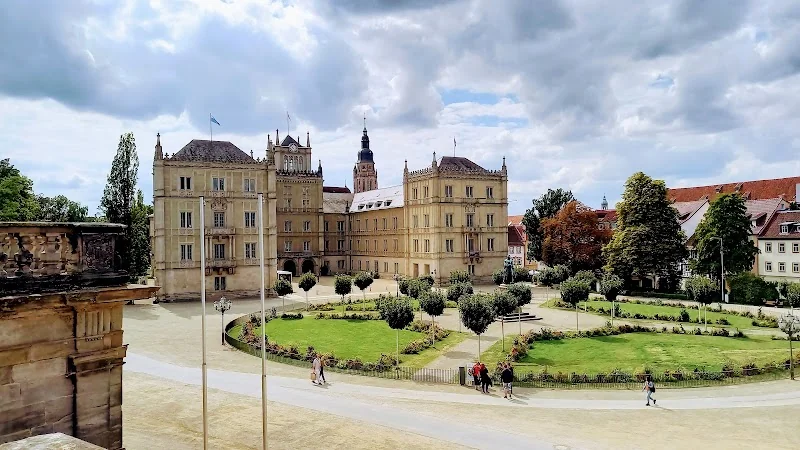
The Schloßplatz Coburg is not an ordinary city square, but one of the defining places in the center of Coburg. Standing here, one looks not just at a square, but at a historical ensemble of residence, theater, court garden, and park architecture. The square lies at the foot of the fortress hill and is framed by the former residence castle Ehrenburg, the arcades with the court garden, Palais Edinburgh, and the state theater. It was designed between 1830 and 1837; in its center stands the monument to Duke Ernst I. This mix of history, scenery, and public space makes the Schloßplatz a place that functions in everyday life as well as during major events. It serves as a meeting point, transition space, photo motif, and stage all at once. For visitors, the square is interesting because many paths are short and Coburg's cultural highlights are concentrated closely together. Those who visit the Schloßplatz experience the city not as a collection of individual sights, but as a cohesive image. This is one of the reasons why the square is so frequently searched in connection with events, theater, arrival, and parking: Here, practical questions meet a particularly strong historical impact. ([coburg.de](https://www.coburg.de/coburg-erleben/sehenswuerdigkeiten/schlossplatz/schlossplatz.php))
Events at Schloßplatz Coburg
When searching for Schloßplatz Coburg, events are at the top of the list of interests. The city explicitly designates the square as a venue for concerts, performances of the Samba Festival, and the annual Schlossplatzfest. This is no coincidence, as the square offers the open form, historical framing, and central location that large open-air formats require. The stage for the Coburg summer program is particularly strong: The International Samba Festival is described by the city as the largest samba festival outside Brazil and has attracted well over 150,000 visitors each year since 1992 on the second weekend of July over three days. Additionally, 3,000 sambistas from ten nations transform Coburg into a colorful festival site. The Schloßplatz is one of the most prominent places of the event and symbolizes the festive cityscape associated with drums, costumes, and Brazilian street samba. The Schlossplatzfest continues this tradition: Five festival days are announced for 2026, with more than 170 shows on two stages and over 800 artists. The Schloßplatz thus becomes an urban festival site that combines culinary offerings, music, and encounters in a setting that can only be found in Coburg. The profile is further complemented by the HUK-COBURG Open Air Summer, which is directly linked to the city's event portal with the Schloßplatz. So, those looking for programs, tickets, or summer events will find one of the city's most important cultural anchor points at Schloßplatz Coburg. ([coburg.de](https://www.coburg.de/coburg-erleben/sehenswuerdigkeiten/schlossplatz/schlossplatz.php))
History, Scenery, and Significant Neighbors
The special charm of the Schloßplatz lies in the fact that its history has remained visible to this day. The square was designed between 1830 and 1837 and is thus a deliberately created urban space of the 19th century. Unlike a randomly grown square, it appears organized, representative, and tailored to the courtly surroundings. This effect makes it so impressive for visitors: It is not an isolated forecourt, but the connecting joint between the most significant buildings in Coburg's city center. The Ehrenburg forms the historical core of this scenery; the city describes it elsewhere as a residence with a history of more than 450 years. The arcades open the view into the court garden, while Palais Edinburgh and the state theater spatially encompass the square and give it its current urban edge. In the center stands the monument to Duke Ernst I., which underscores the representative character of the square. The naming of the surrounding areas also shows how closely history and present are intertwined here: The Schloßplatz is not only a monument space but also a vibrant part of a cultural quarter. Immediately next to it lies the Great House of the Coburg State Theater, a neoclassical building with a horseshoe shape, golden details, and three tiers with a total of 488 seats. Its roots reach back into the city's theater tradition; the building was completed in 1838. Also nearby is the Riding Hall at Schloßplatz 3, originally built in 1852 as a riding stable, later used as a scenery storage, and converted into a studio stage in 1985. With 99 movable seats, it is now a particularly intimate theater venue. Thus, an ensemble forms around the Schloßplatz, where architecture, culture, and history do not stand side by side but reinforce each other. ([coburg.de](https://www.coburg.de/coburg-erleben/sehenswuerdigkeiten/schlossplatz/schlossplatz.php))
Getting to Schloßplatz Coburg: Car, Train, and Public Transport
Getting to Schloßplatz Coburg is relatively uncomplicated thanks to its central location, even though one must expect closures or one-way regulations during large events. For those arriving by car, the city of Coburg points to good accessibility via the A9 as well as the A3 and the A73/A71. This makes the location well connected for visitors from Bavaria, Thuringia, and the rest of southern Germany. Those arriving by train benefit from the fact that Coburg has been an ICE stop in the long-distance network since December 2017. This makes the journey to the city not only easier for day visitors but also for concert and theater attendees. Additionally, the city points to bus connections within the city as well as timetable offers for local public transport. Especially during large events, such as the Samba Festival, the city center is expected to be only partially accessible; then, P+R service and special bus lines are recommended. The event area of the HUK-COBURG Open Air Summer also names the Schloßplatz as a venue and refers to travel planning via the Bavaria timetable. For visitors, this means: The journey can be well planned, but should definitely be checked in advance for festivals and special dates. Therefore, those experiencing the Schloßplatz should not only know the address but also keep an eye on the event-dependent traffic regulations. Especially during major events, the logic in Coburg is clearly focused on short distances, mobility transitions, and central accessibility. This makes the Schloßplatz traffic-wise demanding, but culturally very conveniently reachable. ([www1.coburg.de](https://www1.coburg.de/coburg-erleben/coburg-besuchen/anreise/anreise.php))
Parking at Schloßplatz Coburg and the State Theater
When it comes to parking, Schloßplatz Coburg is particularly interesting because it is used not only as a public square but also as a temporary parking area for theater visitors. The Coburg State Theater states on its service page that the Schloßplatz is available as a parking area one hour before and one hour after the performance, provided that the square is not occupied by a special event. This is practical for visitors because they can get off very close to the venue and do not have to plan long walks. At the same time, the offer remains situation-dependent: In the case of double performances, the square should be cleared quickly after the first performance so that subsequent guests can park. If the Schloßplatz area is unavailable or occupied, the theater names three alternative options: the Anger parking lot, the Albertsplatz underground garage, and the Zinkenwehr parking garage. While these are not directly at the square, they are well usable for the city center. The city of Coburg generally describes its city center as a city of short distances and points to several public parking garages, parking lots, and underground garages. This is particularly important for large summer events because the traffic regulations do not function as on a normal day. During festivals like the Samba Festival or the Schlossplatzfest, the square is partially needed for setup, security, or visitor flows, which can significantly change the parking situation. So, those arriving by car should not only check the location but also the occasion. For theater and cultural visits, however, the Schloßplatz is a very attractive solution because it combines proximity, orientation, and central location in an area that is directly in the city center. Thus, parking at Schloßplatz becomes part of the experience, not just a logistical necessity. ([landestheater-coburg.de](https://landestheater-coburg.de/besuch/service))
Seating Plan, Riding Hall, and Practical Theater Proximity
Many users search for Schloßplatz Coburg together with terms like seating plan, seats, or best seats. This is understandable because the square is located in the immediate vicinity of the state theater and is thus automatically linked to theater tickets, hall plans, and visitor logistics. It is important to make a clear distinction: The Schloßplatz itself does not have a fixed seating plan like a theater building. Those looking for a seating plan must look at the neighboring venues of the state theater. The Great House has three tiers and a total of 488 seats; the Riding Hall at Schloßplatz 3 offers 99 movable seats, providing a very close, flexible audience experience. The theater's seating plan page also makes it clear that the current box office is no longer located at Schloßplatz but at GLOBE Coburg. This is an important practical note for many visitors, as older information online may still suggest the historical theater location at Schloßplatz. At the same time, the Schloßplatz remains relevant as an address and parking area, especially for events at the Riding Hall or in the theater's vicinity. For guests with mobility impairments, the state theater provides barrier-free seats at GLOBE and in the Riding Hall; online booking for wheelchair seats is not possible, but a reservation through the theater box office is required. All of this shows: The Schloßplatz is not just a backdrop but part of a functioning cultural site with clear service pathways. Therefore, those searching for seating plans, tickets, or theater proximity will almost inevitably end up at Schloßplatz and its ensemble. This is even more true as Coburg connects its theater tradition with a dense, well-utilized city center, translating historical architecture into a contemporary visitor situation. ([landestheater-coburg.de](https://www.landestheater-coburg.de/spielorte/grosses-haus/?utm_source=openai))
Why Schloßplatz Coburg is So Special
The Schloßplatz Coburg is so striking because it fulfills several functions simultaneously. It is a historical square, an event venue, a crossroads, a theater environment, and an urban link between residence, court garden, and city center. This multiple role makes it so memorable in the cityscape. Visitors experience here the typical Coburg mix of princely architecture, cultural tradition, and vibrant public space. During the day, the square is open and easily readable; in the evening, it gains atmosphere through lighting, facades, and events. The city showcases the Schloßplatz on its pages from different perspectives, including evening moods, winter panoramas, and shots with Ehrenburg, Rondell, and the Ernst monument. This illustrates that the square is not only functionally conceived but also serves as an urban identity space. Additionally, the court garden as a green neighbor embeds the square in a landscape of nature, walking paths, and culture. This makes the Schloßplatz particularly attractive for visitors who want to experience not just a single event but an entire city moment. In summer, this is even more pronounced: The square becomes a meeting point for thousands of people with festivals and open-air formats, while the historical form remains preserved. This contrast between large public life and courtly scenery is what distinguishes the square from many other city center locations. Therefore, to understand Coburg, one should not only consider the Ehrenburg or the theater individually but view the Schloßplatz as the connecting center in between. It is the place where past, present, and event culture meet in close quarters. This is content-wise interesting, touristically attractive, and particularly relevant for search intentions around events, parking, and arrival. ([coburg.de](https://www.coburg.de/coburg-erleben/sehenswuerdigkeiten/schlossplatz/schlossplatz.php))
Sources:
Mehr anzeigenWeniger anzeigen
Schloßplatz Coburg | Events & Parking
The Schloßplatz Coburg is not an ordinary city square, but one of the defining places in the center of Coburg. Standing here, one looks not just at a square, but at a historical ensemble of residence, theater, court garden, and park architecture. The square lies at the foot of the fortress hill and is framed by the former residence castle Ehrenburg, the arcades with the court garden, Palais Edinburgh, and the state theater. It was designed between 1830 and 1837; in its center stands the monument to Duke Ernst I. This mix of history, scenery, and public space makes the Schloßplatz a place that functions in everyday life as well as during major events. It serves as a meeting point, transition space, photo motif, and stage all at once. For visitors, the square is interesting because many paths are short and Coburg's cultural highlights are concentrated closely together. Those who visit the Schloßplatz experience the city not as a collection of individual sights, but as a cohesive image. This is one of the reasons why the square is so frequently searched in connection with events, theater, arrival, and parking: Here, practical questions meet a particularly strong historical impact. ([coburg.de](https://www.coburg.de/coburg-erleben/sehenswuerdigkeiten/schlossplatz/schlossplatz.php))
Events at Schloßplatz Coburg
When searching for Schloßplatz Coburg, events are at the top of the list of interests. The city explicitly designates the square as a venue for concerts, performances of the Samba Festival, and the annual Schlossplatzfest. This is no coincidence, as the square offers the open form, historical framing, and central location that large open-air formats require. The stage for the Coburg summer program is particularly strong: The International Samba Festival is described by the city as the largest samba festival outside Brazil and has attracted well over 150,000 visitors each year since 1992 on the second weekend of July over three days. Additionally, 3,000 sambistas from ten nations transform Coburg into a colorful festival site. The Schloßplatz is one of the most prominent places of the event and symbolizes the festive cityscape associated with drums, costumes, and Brazilian street samba. The Schlossplatzfest continues this tradition: Five festival days are announced for 2026, with more than 170 shows on two stages and over 800 artists. The Schloßplatz thus becomes an urban festival site that combines culinary offerings, music, and encounters in a setting that can only be found in Coburg. The profile is further complemented by the HUK-COBURG Open Air Summer, which is directly linked to the city's event portal with the Schloßplatz. So, those looking for programs, tickets, or summer events will find one of the city's most important cultural anchor points at Schloßplatz Coburg. ([coburg.de](https://www.coburg.de/coburg-erleben/sehenswuerdigkeiten/schlossplatz/schlossplatz.php))
History, Scenery, and Significant Neighbors
The special charm of the Schloßplatz lies in the fact that its history has remained visible to this day. The square was designed between 1830 and 1837 and is thus a deliberately created urban space of the 19th century. Unlike a randomly grown square, it appears organized, representative, and tailored to the courtly surroundings. This effect makes it so impressive for visitors: It is not an isolated forecourt, but the connecting joint between the most significant buildings in Coburg's city center. The Ehrenburg forms the historical core of this scenery; the city describes it elsewhere as a residence with a history of more than 450 years. The arcades open the view into the court garden, while Palais Edinburgh and the state theater spatially encompass the square and give it its current urban edge. In the center stands the monument to Duke Ernst I., which underscores the representative character of the square. The naming of the surrounding areas also shows how closely history and present are intertwined here: The Schloßplatz is not only a monument space but also a vibrant part of a cultural quarter. Immediately next to it lies the Great House of the Coburg State Theater, a neoclassical building with a horseshoe shape, golden details, and three tiers with a total of 488 seats. Its roots reach back into the city's theater tradition; the building was completed in 1838. Also nearby is the Riding Hall at Schloßplatz 3, originally built in 1852 as a riding stable, later used as a scenery storage, and converted into a studio stage in 1985. With 99 movable seats, it is now a particularly intimate theater venue. Thus, an ensemble forms around the Schloßplatz, where architecture, culture, and history do not stand side by side but reinforce each other. ([coburg.de](https://www.coburg.de/coburg-erleben/sehenswuerdigkeiten/schlossplatz/schlossplatz.php))
Getting to Schloßplatz Coburg: Car, Train, and Public Transport
Getting to Schloßplatz Coburg is relatively uncomplicated thanks to its central location, even though one must expect closures or one-way regulations during large events. For those arriving by car, the city of Coburg points to good accessibility via the A9 as well as the A3 and the A73/A71. This makes the location well connected for visitors from Bavaria, Thuringia, and the rest of southern Germany. Those arriving by train benefit from the fact that Coburg has been an ICE stop in the long-distance network since December 2017. This makes the journey to the city not only easier for day visitors but also for concert and theater attendees. Additionally, the city points to bus connections within the city as well as timetable offers for local public transport. Especially during large events, such as the Samba Festival, the city center is expected to be only partially accessible; then, P+R service and special bus lines are recommended. The event area of the HUK-COBURG Open Air Summer also names the Schloßplatz as a venue and refers to travel planning via the Bavaria timetable. For visitors, this means: The journey can be well planned, but should definitely be checked in advance for festivals and special dates. Therefore, those experiencing the Schloßplatz should not only know the address but also keep an eye on the event-dependent traffic regulations. Especially during major events, the logic in Coburg is clearly focused on short distances, mobility transitions, and central accessibility. This makes the Schloßplatz traffic-wise demanding, but culturally very conveniently reachable. ([www1.coburg.de](https://www1.coburg.de/coburg-erleben/coburg-besuchen/anreise/anreise.php))
Parking at Schloßplatz Coburg and the State Theater
When it comes to parking, Schloßplatz Coburg is particularly interesting because it is used not only as a public square but also as a temporary parking area for theater visitors. The Coburg State Theater states on its service page that the Schloßplatz is available as a parking area one hour before and one hour after the performance, provided that the square is not occupied by a special event. This is practical for visitors because they can get off very close to the venue and do not have to plan long walks. At the same time, the offer remains situation-dependent: In the case of double performances, the square should be cleared quickly after the first performance so that subsequent guests can park. If the Schloßplatz area is unavailable or occupied, the theater names three alternative options: the Anger parking lot, the Albertsplatz underground garage, and the Zinkenwehr parking garage. While these are not directly at the square, they are well usable for the city center. The city of Coburg generally describes its city center as a city of short distances and points to several public parking garages, parking lots, and underground garages. This is particularly important for large summer events because the traffic regulations do not function as on a normal day. During festivals like the Samba Festival or the Schlossplatzfest, the square is partially needed for setup, security, or visitor flows, which can significantly change the parking situation. So, those arriving by car should not only check the location but also the occasion. For theater and cultural visits, however, the Schloßplatz is a very attractive solution because it combines proximity, orientation, and central location in an area that is directly in the city center. Thus, parking at Schloßplatz becomes part of the experience, not just a logistical necessity. ([landestheater-coburg.de](https://landestheater-coburg.de/besuch/service))
Seating Plan, Riding Hall, and Practical Theater Proximity
Many users search for Schloßplatz Coburg together with terms like seating plan, seats, or best seats. This is understandable because the square is located in the immediate vicinity of the state theater and is thus automatically linked to theater tickets, hall plans, and visitor logistics. It is important to make a clear distinction: The Schloßplatz itself does not have a fixed seating plan like a theater building. Those looking for a seating plan must look at the neighboring venues of the state theater. The Great House has three tiers and a total of 488 seats; the Riding Hall at Schloßplatz 3 offers 99 movable seats, providing a very close, flexible audience experience. The theater's seating plan page also makes it clear that the current box office is no longer located at Schloßplatz but at GLOBE Coburg. This is an important practical note for many visitors, as older information online may still suggest the historical theater location at Schloßplatz. At the same time, the Schloßplatz remains relevant as an address and parking area, especially for events at the Riding Hall or in the theater's vicinity. For guests with mobility impairments, the state theater provides barrier-free seats at GLOBE and in the Riding Hall; online booking for wheelchair seats is not possible, but a reservation through the theater box office is required. All of this shows: The Schloßplatz is not just a backdrop but part of a functioning cultural site with clear service pathways. Therefore, those searching for seating plans, tickets, or theater proximity will almost inevitably end up at Schloßplatz and its ensemble. This is even more true as Coburg connects its theater tradition with a dense, well-utilized city center, translating historical architecture into a contemporary visitor situation. ([landestheater-coburg.de](https://www.landestheater-coburg.de/spielorte/grosses-haus/?utm_source=openai))
Why Schloßplatz Coburg is So Special
The Schloßplatz Coburg is so striking because it fulfills several functions simultaneously. It is a historical square, an event venue, a crossroads, a theater environment, and an urban link between residence, court garden, and city center. This multiple role makes it so memorable in the cityscape. Visitors experience here the typical Coburg mix of princely architecture, cultural tradition, and vibrant public space. During the day, the square is open and easily readable; in the evening, it gains atmosphere through lighting, facades, and events. The city showcases the Schloßplatz on its pages from different perspectives, including evening moods, winter panoramas, and shots with Ehrenburg, Rondell, and the Ernst monument. This illustrates that the square is not only functionally conceived but also serves as an urban identity space. Additionally, the court garden as a green neighbor embeds the square in a landscape of nature, walking paths, and culture. This makes the Schloßplatz particularly attractive for visitors who want to experience not just a single event but an entire city moment. In summer, this is even more pronounced: The square becomes a meeting point for thousands of people with festivals and open-air formats, while the historical form remains preserved. This contrast between large public life and courtly scenery is what distinguishes the square from many other city center locations. Therefore, to understand Coburg, one should not only consider the Ehrenburg or the theater individually but view the Schloßplatz as the connecting center in between. It is the place where past, present, and event culture meet in close quarters. This is content-wise interesting, touristically attractive, and particularly relevant for search intentions around events, parking, and arrival. ([coburg.de](https://www.coburg.de/coburg-erleben/sehenswuerdigkeiten/schlossplatz/schlossplatz.php))
Sources:
Schloßplatz Coburg | Events & Parking
The Schloßplatz Coburg is not an ordinary city square, but one of the defining places in the center of Coburg. Standing here, one looks not just at a square, but at a historical ensemble of residence, theater, court garden, and park architecture. The square lies at the foot of the fortress hill and is framed by the former residence castle Ehrenburg, the arcades with the court garden, Palais Edinburgh, and the state theater. It was designed between 1830 and 1837; in its center stands the monument to Duke Ernst I. This mix of history, scenery, and public space makes the Schloßplatz a place that functions in everyday life as well as during major events. It serves as a meeting point, transition space, photo motif, and stage all at once. For visitors, the square is interesting because many paths are short and Coburg's cultural highlights are concentrated closely together. Those who visit the Schloßplatz experience the city not as a collection of individual sights, but as a cohesive image. This is one of the reasons why the square is so frequently searched in connection with events, theater, arrival, and parking: Here, practical questions meet a particularly strong historical impact. ([coburg.de](https://www.coburg.de/coburg-erleben/sehenswuerdigkeiten/schlossplatz/schlossplatz.php))
Events at Schloßplatz Coburg
When searching for Schloßplatz Coburg, events are at the top of the list of interests. The city explicitly designates the square as a venue for concerts, performances of the Samba Festival, and the annual Schlossplatzfest. This is no coincidence, as the square offers the open form, historical framing, and central location that large open-air formats require. The stage for the Coburg summer program is particularly strong: The International Samba Festival is described by the city as the largest samba festival outside Brazil and has attracted well over 150,000 visitors each year since 1992 on the second weekend of July over three days. Additionally, 3,000 sambistas from ten nations transform Coburg into a colorful festival site. The Schloßplatz is one of the most prominent places of the event and symbolizes the festive cityscape associated with drums, costumes, and Brazilian street samba. The Schlossplatzfest continues this tradition: Five festival days are announced for 2026, with more than 170 shows on two stages and over 800 artists. The Schloßplatz thus becomes an urban festival site that combines culinary offerings, music, and encounters in a setting that can only be found in Coburg. The profile is further complemented by the HUK-COBURG Open Air Summer, which is directly linked to the city's event portal with the Schloßplatz. So, those looking for programs, tickets, or summer events will find one of the city's most important cultural anchor points at Schloßplatz Coburg. ([coburg.de](https://www.coburg.de/coburg-erleben/sehenswuerdigkeiten/schlossplatz/schlossplatz.php))
History, Scenery, and Significant Neighbors
The special charm of the Schloßplatz lies in the fact that its history has remained visible to this day. The square was designed between 1830 and 1837 and is thus a deliberately created urban space of the 19th century. Unlike a randomly grown square, it appears organized, representative, and tailored to the courtly surroundings. This effect makes it so impressive for visitors: It is not an isolated forecourt, but the connecting joint between the most significant buildings in Coburg's city center. The Ehrenburg forms the historical core of this scenery; the city describes it elsewhere as a residence with a history of more than 450 years. The arcades open the view into the court garden, while Palais Edinburgh and the state theater spatially encompass the square and give it its current urban edge. In the center stands the monument to Duke Ernst I., which underscores the representative character of the square. The naming of the surrounding areas also shows how closely history and present are intertwined here: The Schloßplatz is not only a monument space but also a vibrant part of a cultural quarter. Immediately next to it lies the Great House of the Coburg State Theater, a neoclassical building with a horseshoe shape, golden details, and three tiers with a total of 488 seats. Its roots reach back into the city's theater tradition; the building was completed in 1838. Also nearby is the Riding Hall at Schloßplatz 3, originally built in 1852 as a riding stable, later used as a scenery storage, and converted into a studio stage in 1985. With 99 movable seats, it is now a particularly intimate theater venue. Thus, an ensemble forms around the Schloßplatz, where architecture, culture, and history do not stand side by side but reinforce each other. ([coburg.de](https://www.coburg.de/coburg-erleben/sehenswuerdigkeiten/schlossplatz/schlossplatz.php))
Getting to Schloßplatz Coburg: Car, Train, and Public Transport
Getting to Schloßplatz Coburg is relatively uncomplicated thanks to its central location, even though one must expect closures or one-way regulations during large events. For those arriving by car, the city of Coburg points to good accessibility via the A9 as well as the A3 and the A73/A71. This makes the location well connected for visitors from Bavaria, Thuringia, and the rest of southern Germany. Those arriving by train benefit from the fact that Coburg has been an ICE stop in the long-distance network since December 2017. This makes the journey to the city not only easier for day visitors but also for concert and theater attendees. Additionally, the city points to bus connections within the city as well as timetable offers for local public transport. Especially during large events, such as the Samba Festival, the city center is expected to be only partially accessible; then, P+R service and special bus lines are recommended. The event area of the HUK-COBURG Open Air Summer also names the Schloßplatz as a venue and refers to travel planning via the Bavaria timetable. For visitors, this means: The journey can be well planned, but should definitely be checked in advance for festivals and special dates. Therefore, those experiencing the Schloßplatz should not only know the address but also keep an eye on the event-dependent traffic regulations. Especially during major events, the logic in Coburg is clearly focused on short distances, mobility transitions, and central accessibility. This makes the Schloßplatz traffic-wise demanding, but culturally very conveniently reachable. ([www1.coburg.de](https://www1.coburg.de/coburg-erleben/coburg-besuchen/anreise/anreise.php))
Parking at Schloßplatz Coburg and the State Theater
When it comes to parking, Schloßplatz Coburg is particularly interesting because it is used not only as a public square but also as a temporary parking area for theater visitors. The Coburg State Theater states on its service page that the Schloßplatz is available as a parking area one hour before and one hour after the performance, provided that the square is not occupied by a special event. This is practical for visitors because they can get off very close to the venue and do not have to plan long walks. At the same time, the offer remains situation-dependent: In the case of double performances, the square should be cleared quickly after the first performance so that subsequent guests can park. If the Schloßplatz area is unavailable or occupied, the theater names three alternative options: the Anger parking lot, the Albertsplatz underground garage, and the Zinkenwehr parking garage. While these are not directly at the square, they are well usable for the city center. The city of Coburg generally describes its city center as a city of short distances and points to several public parking garages, parking lots, and underground garages. This is particularly important for large summer events because the traffic regulations do not function as on a normal day. During festivals like the Samba Festival or the Schlossplatzfest, the square is partially needed for setup, security, or visitor flows, which can significantly change the parking situation. So, those arriving by car should not only check the location but also the occasion. For theater and cultural visits, however, the Schloßplatz is a very attractive solution because it combines proximity, orientation, and central location in an area that is directly in the city center. Thus, parking at Schloßplatz becomes part of the experience, not just a logistical necessity. ([landestheater-coburg.de](https://landestheater-coburg.de/besuch/service))
Seating Plan, Riding Hall, and Practical Theater Proximity
Many users search for Schloßplatz Coburg together with terms like seating plan, seats, or best seats. This is understandable because the square is located in the immediate vicinity of the state theater and is thus automatically linked to theater tickets, hall plans, and visitor logistics. It is important to make a clear distinction: The Schloßplatz itself does not have a fixed seating plan like a theater building. Those looking for a seating plan must look at the neighboring venues of the state theater. The Great House has three tiers and a total of 488 seats; the Riding Hall at Schloßplatz 3 offers 99 movable seats, providing a very close, flexible audience experience. The theater's seating plan page also makes it clear that the current box office is no longer located at Schloßplatz but at GLOBE Coburg. This is an important practical note for many visitors, as older information online may still suggest the historical theater location at Schloßplatz. At the same time, the Schloßplatz remains relevant as an address and parking area, especially for events at the Riding Hall or in the theater's vicinity. For guests with mobility impairments, the state theater provides barrier-free seats at GLOBE and in the Riding Hall; online booking for wheelchair seats is not possible, but a reservation through the theater box office is required. All of this shows: The Schloßplatz is not just a backdrop but part of a functioning cultural site with clear service pathways. Therefore, those searching for seating plans, tickets, or theater proximity will almost inevitably end up at Schloßplatz and its ensemble. This is even more true as Coburg connects its theater tradition with a dense, well-utilized city center, translating historical architecture into a contemporary visitor situation. ([landestheater-coburg.de](https://www.landestheater-coburg.de/spielorte/grosses-haus/?utm_source=openai))
Why Schloßplatz Coburg is So Special
The Schloßplatz Coburg is so striking because it fulfills several functions simultaneously. It is a historical square, an event venue, a crossroads, a theater environment, and an urban link between residence, court garden, and city center. This multiple role makes it so memorable in the cityscape. Visitors experience here the typical Coburg mix of princely architecture, cultural tradition, and vibrant public space. During the day, the square is open and easily readable; in the evening, it gains atmosphere through lighting, facades, and events. The city showcases the Schloßplatz on its pages from different perspectives, including evening moods, winter panoramas, and shots with Ehrenburg, Rondell, and the Ernst monument. This illustrates that the square is not only functionally conceived but also serves as an urban identity space. Additionally, the court garden as a green neighbor embeds the square in a landscape of nature, walking paths, and culture. This makes the Schloßplatz particularly attractive for visitors who want to experience not just a single event but an entire city moment. In summer, this is even more pronounced: The square becomes a meeting point for thousands of people with festivals and open-air formats, while the historical form remains preserved. This contrast between large public life and courtly scenery is what distinguishes the square from many other city center locations. Therefore, to understand Coburg, one should not only consider the Ehrenburg or the theater individually but view the Schloßplatz as the connecting center in between. It is the place where past, present, and event culture meet in close quarters. This is content-wise interesting, touristically attractive, and particularly relevant for search intentions around events, parking, and arrival. ([coburg.de](https://www.coburg.de/coburg-erleben/sehenswuerdigkeiten/schlossplatz/schlossplatz.php))
Sources:
Upcoming Events
No events found
Frequently Asked Questions
Reviews
No reviews found