
Hans Alvesen
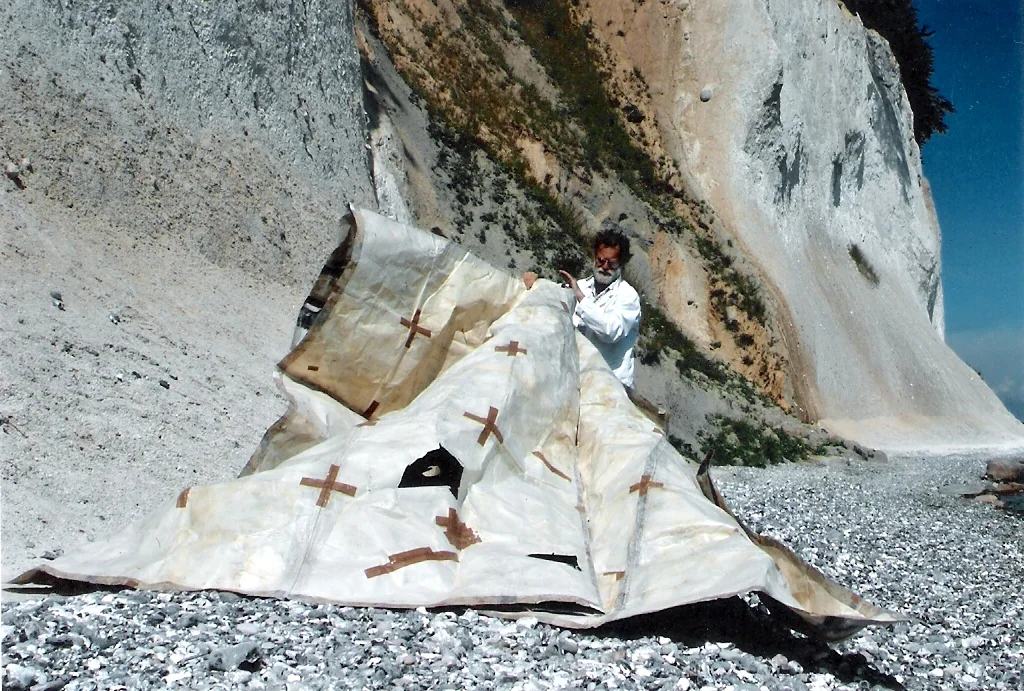
Image from Wikipedia
Image from Wikipedia
Hans Alvesen – Poet of the Surface, Master of Situational Sculpture, and Border-Crosser between Paper, Space, and Sound
An Artist Who Transforms Material into Motion
Hans Alvesen, born Michael Anlauf, is among those German artistic personalities whose work transcends a single discipline. Born on April 3, 1943, in Rützen/Guhrau, his life journey took him from Lower Silesia through several educational stages and international travels to Braunschweig, where he still lives and works. His oeuvre revolves around paper, space, landscape, and sacred places, developing a distinctive visual language between sculpture, relief, writing, and movement. ([de.wikipedia.org](https://de.wikipedia.org/wiki/Hans_Alvesen))
Biography: From Post-War Fate to Artistic Independence
Alvesen was born as the son of a pastor, and even his early biography is marked by upheaval: in 1945, the family fled to Alvesen, a district of Hilgermissen. In 1962, he graduated from high school in Verden an der Aller and then began his artistic training with the church painter Hermann Oetken. Study trips to Florence, Rome, Naples, and Palermo opened his perspective on early Christian imagery and art where material, ritual, and space are inseparably connected. ([de.wikipedia.org](https://de.wikipedia.org/wiki/Hans_Alvesen))
The academic influence deepened at the Academy of Fine Arts in Munich with Franz Nagel and later at the Academy of Fine Arts in Karlsruhe with Emil Schumacher. Additionally, encounters with sculptor Wilhelm Loth and longer stays abroad in Western Europe, as well as a seven-month journey following the traces of pre-Columbian cultures, shaped an artist who understands cultural horizons not as decoration but as a spiritual and formal resource. ([de.wikipedia.org](https://de.wikipedia.org/wiki/Hans_Alvesen))
The Path to Braunschweig and the Development of His Own Vocabulary
In 1975, Alvesen continued his study of free art at the University of Fine Arts Braunschweig, first with Alfred Winter-Rust, later with Emil Cimiotti. In 1976, he adopted the artist name Hans Alvesen; by 1978, he had become a master student. This phase marks a decisive step towards a distinctive artistic signature that is no longer derived from teachers or schools but emerges from rigorous material research and spatial awareness. ([de.wikipedia.org](https://de.wikipedia.org/wiki/Hans_Alvesen))
Important scholarships accompanied his journey, enabling travel and work in landscapes and sacred spaces. It is in such places that his work gains particular intensity: not in the neutral white cube but in dialogue with architecture, wind, light, and spiritual spaces. His inclusion in the artist database and estate archive of Lower Saxony underscores the institutional grounding of his oeuvre. ([de.wikipedia.org](https://de.wikipedia.org/wiki/Hans_Alvesen))
Material as Language: Paper, Relief, Action, and “Situational Sculpture”
The heart of Hans Alvesen's art is the material paper. He kneads, tears, paints, and writes on it, forming relief images and large surfaces that react to the wind in outdoor spaces and take on tent-like triangular shapes. For this process-oriented approach, he coined the term "Situational Sculpture" – a term that precisely describes his stance: the artwork remains open, responds to its environment and moment, and thus possesses enormous presence. ([de.wikipedia.org](https://de.wikipedia.org/wiki/Hans_Alvesen))
His long-term project "The Paths – The Wind," which he has been continuing annually since 1995 on Greek islands and in the Baltic Sea, is particularly impressive. Here, landscape, movement, and material merge into a sculptural experience that does not aim for durability but for perception, transformation, and trace. It is in this openness that the strength of his work lies: it conceives sculpture not as a monumental assertion but as a dialogical form in space. ([de.wikipedia.org](https://de.wikipedia.org/wiki/Hans_Alvesen))
Between Image, Text, and Sound: Works in Sacred Spaces
Another key to Alvesen's work lies in his collaboration with cellist Ellen Maria Kienhorst. Together, they realize works that emerge in sacred spaces and make intervals, rhythms, and written word visible. In these projects, Alvesen approaches the interface where visual art, music, and language become an integrated whole—not illustratively, but as a composition. ([de.wikipedia.org](https://de.wikipedia.org/wiki/Hans_Alvesen))
This is particularly evident in the "Word-Color-Sound-Images" he has developed in recent years. Here, writing, color, and music form a unity, and it is precisely here that the artistic consistency of his work reveals itself: the pictorial space becomes a score, and the surface acts as a resonator. This is not just a mere intermedial gesture but a well-crafted artistic strategy that gives depth and recognizability to his work. ([de.wikipedia.org](https://de.wikipedia.org/wiki/Hans_Alvesen))
Current Presence: Exhibitions and Living Relevance
Even in advanced age, Hans Alvesen remains active in exhibitions. The Torhaus Gallery of the Botanical Garden of TU Braunschweig showcased digital images and sculptures by the Braunschweig artist in March 2026; the event also announced a accompanying brochure titled "Brother Tree." Such presentations demonstrate that Alvesen's work is not perceived as archival material, but rather as a current artistic position with ongoing resonance. ([magazin.tu-braunschweig.de](https://magazin.tu-braunschweig.de/event/hans-alvesen-ausstellung-in-der-torhausgalerie-des-botanischen-gartens-2/))
His work has been visible in museum and curatorial contexts from early on. A publication from the Van Abbe Museum references an exhibition in Lübeck from 1983, describing that paper forms the basis for his images, reliefs, and sculptures. This early reception shows how clear his formal idea was even then: a work made from paper can be as sophisticated, memorable, and impactful in space as any classic sculpture. ([vanabbemuseum.nl](https://vanabbemuseum.nl/en/collection-research/library/publications/hans-alvesen))
Awards, Collection Context, and Art Historical Significance
Hans Alvesen has received several scholarships, including the 1981 scholarship from the Friends of HBK Braunschweig, a Lower Saxony young artist scholarship in 1982, a travel scholarship from the Alexander Dorner Circle of Hannover in 1983, and an artist scholarship from the state of Lower Saxony in 1986. In 1988, he was a guest at the print workshop of the Städtische Galerie Schloss Wolfsburg. These grants signify not only recognition but also the institutional acknowledgment of a work that has remained consistent and distinctive in its material aesthetics. ([de.wikipedia.org](https://de.wikipedia.org/wiki/Hans_Alvesen))
The presence of Alvesen's works in significant public collections—including the Herzog Anton Ulrich Museum Braunschweig, the Sprengel Collection at the Kunstmuseum Hannover, the National Museum Krakow, and the Kunsthalle Bremen—underscores his cultural-historical relevance. His work inhabits the tension between post-war modernity, experimental object art, and spiritually charged spatial thinking. It is this complexity that makes him an exciting figure for arts enthusiasts and collectors alike. ([de.wikipedia.org](https://de.wikipedia.org/wiki/Hans_Alvesen))
Stylistic Signature and Cultural Influence
Alvesen's style thrives on reduction and condensation. For him, paper is not merely a carrier material in the conventional sense, but an acoustically and optically charged body that retains folds, cuts, writing, and color. In the connection of action, sculpture, and landscape, a type of art emerges that does not conceal the provisional but embraces it as quality. This perspective links him with central questions of contemporary art: How does form relate to the environment? How can material carry meaning? How does space become an event? ([de.wikipedia.org](https://de.wikipedia.org/wiki/Hans_Alvesen))
His cultural influence lies less in loud gestures than in a quiet yet sustainable expansion of the concept of art. Alvesen demonstrates that sculpture does not need to be tied to bronze or stone, and that visual art can create new resonating spaces in dialogue with music, text, and nature. In an age where many works seem quickly consumable, his art asserts the dignity of process, concentration, and sensory experience. ([de.wikipedia.org](https://de.wikipedia.org/wiki/Hans_Alvesen))
Conclusion: An Artist of Quiet Intensity
Hans Alvesen is an artist for all who understand art not as surface but as experience. His works connect biographical depth, precise material aesthetics, and a rare openness to space, nature, and sound. For this reason, his work is always worth a fresh look: it is poetic, unique, and strikingly timeless in its consistency. Anyone wishing to experience contemporary art with intellectual substance should definitely discover Hans Alvesen in the exhibition space and in vibrant dialogue with his sculptures. ([de.wikipedia.org](https://de.wikipedia.org/wiki/Hans_Alvesen))
Official Channels of Hans Alvesen:
- Instagram: No official profile found
- Facebook: No official profile found
- YouTube: No official profile found
- Spotify: No official profile found
- TikTok: No official profile found
Sources:
Upcoming Events
Hans Alvesen - Digital Pictures and Sculptures in the Torhaus Gallery of the Botanical Garden
Discover Hans Alvesen in the Botanical Garden Braunschweig: Digital pictures and sculptures in a quiet, poetic spatial effect. March 1-22, 2026, free entry. #Art
HANS ALVESEN – Exhibition at the Torhaus Gallery
Art between garden and Torhaus: Hans Alvesen shows digital images and sculptures in Braunschweig. Free entry, poetic and close to nature. #Art