
Hugo Harrer
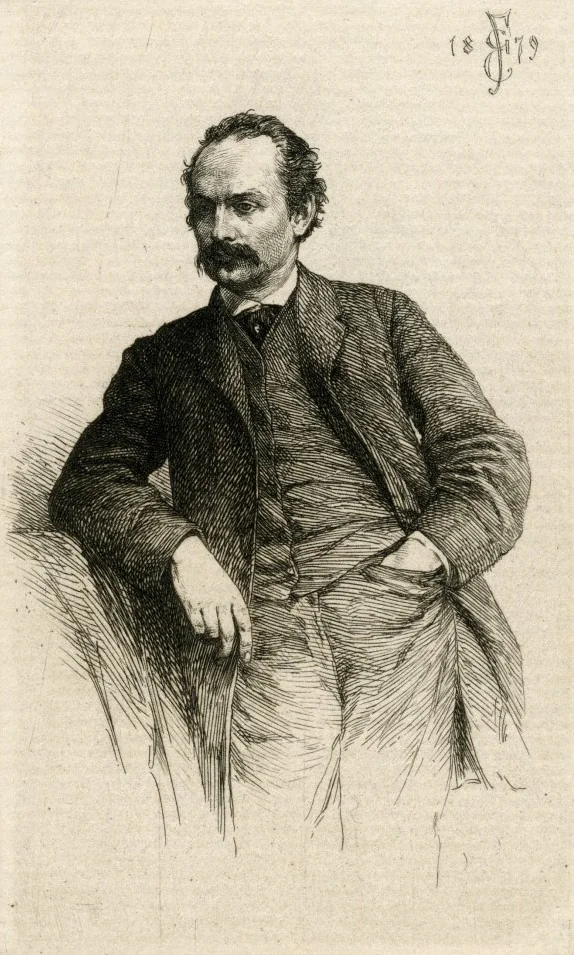
Image from Wikipedia
Image from Wikipedia
Hugo Harrer – Architecture, Landscape and the Exact View of the Düsseldorf School
A Painter Between Training, Self-Teaching and the Italian Image World
Hugo Paul Harrer belonged to that generation of 19th-century German artists who navigated between academic training, independent study, and international mobility. Born on February 6, 1836, in Eberswalde and dying in Rome in 1876, he evolved into a landscape and architectural painter of the Düsseldorf School. His work combines topographical accuracy with a sensitive, atmospheric perception of urban and coastal landscapes.
Particularly fascinating is Harrer's journey as an artist: He began an architectural education but soon turned to painting as a self-taught artist. Through private study in the ateliers of friends, observing nature, and later studying at the Düsseldorf Academy of Arts, he developed a visual language that was grounded in reality while simultaneously creating a poetic, historically charged view of the world. This connection is where the lasting fascination of his artistic development lies.
Biographical Beginnings: From Architecture Student to Painter
Harrer’s early years already reveal the typical conflict found in many 19th-century artist biographies: the desire for a solid, bourgeois-approved career clashes with a stronger internal commitment to art. Instead of becoming an architect, Harrer sought his own path in painting. This decision shaped his entire music career in a metaphorical sense of his artistic journey – as a consistent development of an independent perspective on form, space, and light.
His first paintings were created in Nuremberg, where the historical architecture inspired him to early attempts at architectural painting. Later, he moved to Munich to find inspiration in the painting of Carl Theodor von Piloty. The move to Rome, initially for a chest ailment in 1861 or in October 1862, became a pivotal turning point: there he joined Ludwig Passini and worked on nature studies that would significantly shape his future work.
Düsseldorf, Malkasten and the Influence of Landscape Painting
In the years 1867/1868, Harrer was in Düsseldorf, the center of a far-reaching painting school. At the Academy of Arts, he studied in the landscape class of Oswald Achenbach, one of the formative names of the Düsseldorf School. This stage stylistically anchored him in a tradition that understood landscape not just as a motif but as a compositional and atmospheric organizing principle.
From 1868 to 1872, Harrer was a member of the Düsseldorf artist association Malkasten. This affiliation indicates his involvement in a vibrant network of artists, debates, and exhibitions. The association stood for exchange, public exposure, and artistic self-reflection – conditions under which Harrer sharpened his observational skills and further developed his pictorial themes.
Rome as an Artistic Center: Studies, Sketches and Oil Paintings
After his time in Düsseldorf, Harrer moved back to Rome. There, he amassed a large supply of studies and sketches that served as templates for oil paintings and led him to German art exhibitions. For him, Rome was not just a place of residence but a visual laboratory where he translated architecture, ruins, street scenes, and coastal landscapes into a dense visual archive.
It is particularly these themes from Rome that make Harrer’s work so characteristic. He was interested in painterly representations of street scenes and ruins, as well as Italian coastal landscapes. In the connection of architectural and landscape painting, a trained eye for perspective, spatial depth, and historical mood is revealed – qualities that make his paintings art historically significant even today.
Works and Selection: Between Vedute, Ruins and Coastal Light
Among the preserved works are Old Hanse from 1868, View of the Amalfi Coast at Dusk from 1871, and At the Theater of Marcellus in Rome from 1876. Theater of Marcellus in Rome from the same year is also part of his well-known oeuvre and is located in the National Gallery in Berlin. These titles show Harrer’s preferred visual spaces: historical architecture, Mediterranean coasts, and urban scenes with a narrative character.
Another mentioned motif is A Jewish Street Vendor in a Street in Siena. Such subjects indicate Harrer's interest in everyday scenes within historical urban spaces. His painting thus moves not only in the realm of pure vedute but combines observation, social depiction, and architectural order into an independent form of seeing.
Stylistic Classification: Modern Realism and Careful Nature Observation
The German Biography describes Harrer as "an entirely modern realist," who wanted to depict objects exactly as he saw them. This characterization strikes at the heart of his artistic approach. Harrer's painting follows not a decorative randomness but a precise, observant method, focusing on fidelity to nature, the effects of light, and spatial credibility.
His training through private studies rather than through a continuous academic career apparently reinforced this independent realism. He worked carefully from nature, drawing from direct impressions and transferring them into a clearly structured pictorial composition. Particularly in the Düsseldorf School of Painting, which does not adhere to a uniform style program, Harrer occupies a place between landscape sensitivity and architectural precision.
Cultural Context: The Düsseldorf School and Its International Influence
The Düsseldorf School of Painting was one of the influential art milieus of the 19th century and reached far beyond the Rhine. Harrer's biography exemplifies how international this school was: Nuremberg, Munich, Rome, and Düsseldorf became stations in an artistic life marked by movement, study, and exchange. In this context, Harrer becomes a painter of movement between the centers of European art.
His work also fits into the larger tradition of architectural and landscape painting as it was practiced in Düsseldorf. Unlike large-format historical painting, this genre thrives on perspective, detail accuracy, and the ability to stage places as cultural memory spaces. Harrer's paintings preserve exactly this tension between documentation and mood.
Aftermath and Art Historical Significance
Hugo Harrer died on December 10, 1876, in Rome and was buried in the Protestant Cemetery in Rome. His name does not stand for the grand canon of popular painting, but rather for a knowledgeable, solid, and stylistically conscious artistic existence. Such biographies form the backbone of art history, as they show how schools, regions, and international influences converge in a work.
The art historical relevance of Harrer lies in his connection of architectural painting, landscape observation, and realistic precision. His paintings of ruins, street scenes, and Italian coastal landscapes provide a view of the 19th century that is neither pathetic nor superficial. Those interested in the Düsseldorf School discover in Harrer a quiet but important representative of this tradition.
Conclusion: An Underrated Master of Accurate Observation
Hugo Harrer is fascinating because he has consistently followed the path from architecture student to independently working realist. His career between Nuremberg, Munich, Düsseldorf, and Rome reflects an artistic life shaped by discipline, sharp vision, and European experience. Those who view his works encounter a painting that not only depicts historical spaces but also imbues them with atmosphere.
This is precisely the allure of this artist: Harrer combines architecture, landscape, and urban scenes into images of quiet intensity. His art deserves attention in museums, collections, and art historical research. Anyone wanting to experience the Düsseldorf School live in its original form should definitely study Harrer's preserved works in direct visual contact.
Official Channels of Hugo Harrer:
- Instagram: No official profile found
- Facebook: No official profile found
- YouTube: No official profile found
- Spotify: No official profile found
- TikTok: No official profile found