
Rainald Grebe
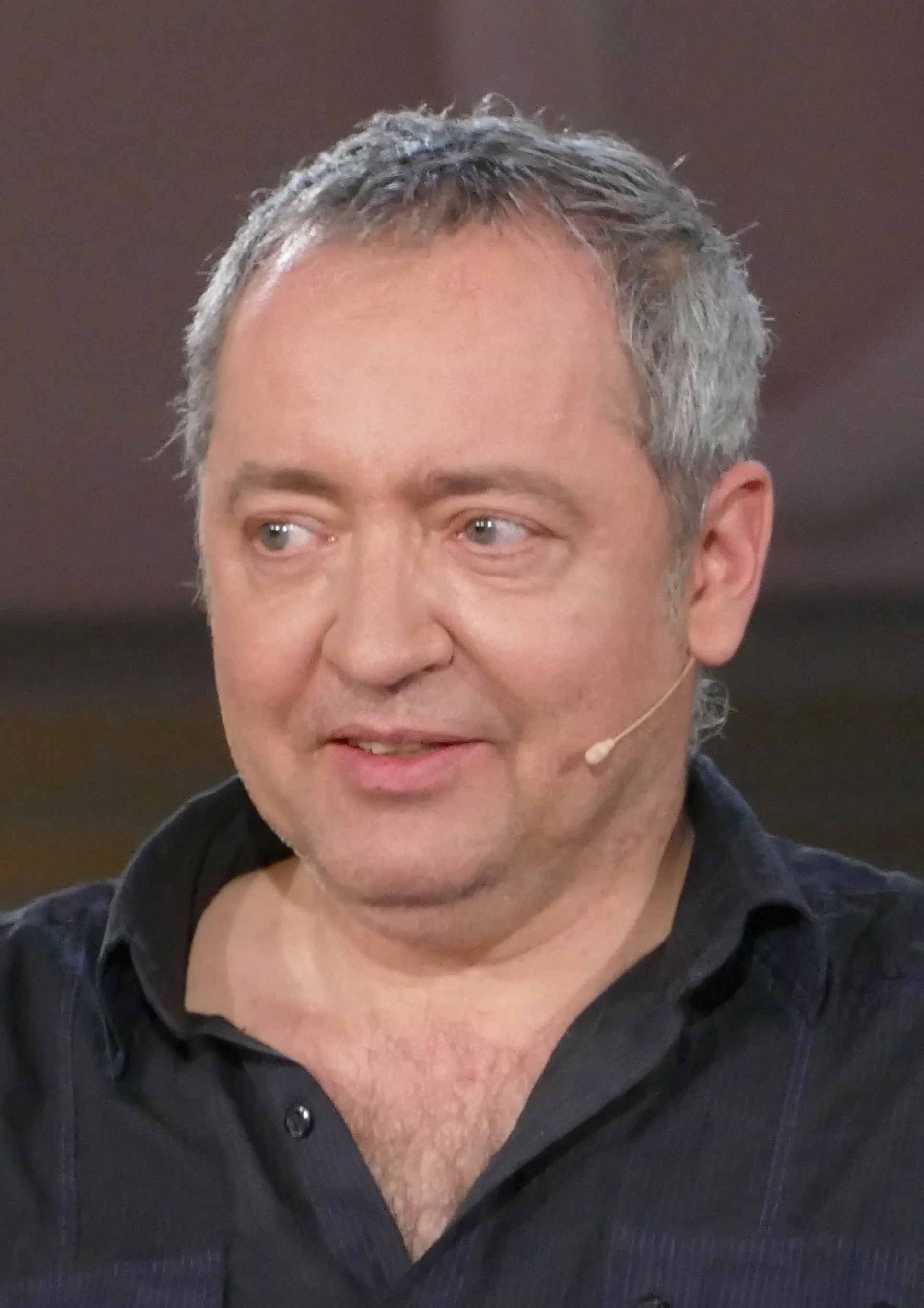
Image from Wikipedia
Image from Wikipedia
Rainald Grebe – The Singing Observer of Germany Between Cabaret, Chanson, and Theater
An artist who reflects the Republic with irony, pain, and great stage poetry
Rainald Grebe, born in 1971 in Cologne, is one of the most distinctive and unmistakable voices in the German-speaking music and cabaret scene. As a songwriter, actor, cabaret artist, theater director, and author, he has been moving at the intersections of music, satire, and theater for decades. His works combine sharply observed everyday language, grotesque humor, and a profound understanding of German moods into an art form that is both comical, melancholic, and highly political. ([wortart-shop.de](https://www.wortart-shop.de/kuenstler/rainald-grebe/))
Biographical Roots and Artistic Influence
Grebe grew up in Frechen near Cologne and took an artistic path early on that initially led him to training at the renowned Ernst Busch School in Berlin. He graduated in 1993 as a qualified puppeteer – a detail that reveals much about his later stage aesthetics: precision, role changes, exaggeration, and a keen sense for the mechanics of characters. He then worked at the Theaterhaus Jena, gaining experiences that shaped his understanding of the stage as a living commentary space. ([planet-interview.de](https://www.planet-interview.de/interviews/rainald-grebe/52283/?utm_source=openai))
It was clear from an early age that Grebe was not striving for a smooth entertainment career, but rather an artistic development that defies categorization. His early performances on comedy and cabaret stages, such as the Quatsch Comedy Club and NightWash, made him known to a wider audience. At the same time, theater remained a central place in his music career, as he developed the dramatic precision that still characterizes his songs and programs today. ([hannover.t-online.de](https://hannover.t-online.de/region/hannover/id_101122594/rainald-grebe-rueckkehr-nach-schlaganfaellen-mit-konzert-in-hannover.html?utm_source=openai))
The Breakthrough: Folk Music, Brandenburg, and the Art of the State Anthem
The actual breakthrough did not come through mainstream pop, but rather through a song that has imprinted itself into the collective memory of many listeners: Brandenburg. This anti-anthem became his most famous hit and epitomizes Grebe's method of transforming regional pathos into ironic observations of the present. Thuringia and Doreen from Mecklenburg are also part of the state songs through which he incisively dissects regional identities, clichés, and self-images. ([zeit.de](https://www.zeit.de/2010/43/Rainald-Grebe?utm_source=openai))
With the album Volksmusik, Grebe didn't merely stage a genre in 2007, but deliberately twisted it through the nonsense mill. The album made clear how adeptly he intertwines folk music, chanson, NDW, rock, and cabaret. It is precisely this mixture of melody, wit, and analytical sharpness that has made him a singing chronicler of German contemporary life, with the music press perceiving him as an ironic observer as well as a serious songwriter. ([kulturnews.de](https://kulturnews.de/rainald-grebe-ernst-sein-ist-alles/?utm_source=openai))
Musical Development: From Solo Nights to the Orchestra of Reconciliation
Grebe's discography shows a consistent movement between solo formats, band work, and large-scale stage projects. After his debut Solo, followed live and studio productions like Das Abschiedskonzert, Das Robinson Crusoe Konzert, Das Hongkongkonzert, and Das Rainald Grebe Konzert. Later, formations like the Kapelle der Versöhnung and the Orchester der Versöhnung added more sonic breadth, ensemble power, and theatrical depth to his songs. ([de.wikipedia.org](https://de.wikipedia.org/wiki/Rainald_Grebe))
Especially important is the connection between arrangement and text. Grebe often works with sudden shifts in perspective, earworm-quality choruses, and musical quotes ranging from chanson to pop. Reviews have described his music as dadaistic montages or as pop music with a self-reflective twist; at the same time, they emphasized his ability to translate societal observations into catchy forms without losing their bite. ([deutschlandfunkkultur.de](https://www.deutschlandfunkkultur.de/popmusik-von-rainald-grebe-dadaistische-montagen-100.html?utm_source=openai))
Theater, Direction, and Political Music Theater
Grebe's work is unimaginable without theater. He wrote and directed plays at the Maxim Gorki Theater, the Schaubühne, Schauspiel Köln, Schauspiel Frankfurt, Staatstheater Hannover, and other venues. His productions combine music, scenic revue, and political diagnosis of contemporary issues; works like Zurück zur Natur, Völker schaut auf diese Stadt, or fontane.200 show clearly how closely language, composition, and stage concept are linked in his work. ([de.wikipedia.org](https://de.wikipedia.org/wiki/Rainald_Grebe))
This theatrical practice enhances his authority as an artist with genuine dramatic experience. He thinks of songs not just as standalone pieces, but as parts of evenings, characters, and narrative arcs. It is from this that the special stage presence arises, with which Grebe engages the audience between laughter, irritation, and quiet empathy. ([urbanite.net](https://www.urbanite.net/leipzig/artikel/keine-komik-ohne-tragik-rainald-grebe-im-interview/?utm_source=openai))
Current Projects, Illness, and Return to the Stage
Even in 2024 and 2025, Grebe remained artistically active, although his health interrupted his work several times. Starting in May 2024, he toured solo with the Foreveryoung Konzert, and from June 2024, he additionally performed with the Kapelle der Versöhnung in the program Die Band. In October 2024, further tours were canceled due to health issues, after he had already suffered multiple strokes; in 2021, he also publicly experienced a vasculitis. ([de.wikipedia.org](https://de.wikipedia.org/wiki/Rainald_Grebe))
His return became a topic again in 2026 when reports about new concerts and an additional performance in Hannover emerged. At the same time, the 3sat and ZDF-related documentary format Rainald Grebe: Der Tod im Leben highlighted how closely intertwined his life crises and artistic productivity are. This constellation reinforces the impression of an artist who understands art not as a pose, but as a form of survival. ([zdf.de](https://www.zdf.de/video/dokus/kulturdoku-100/rainald-grebe-der-tod-im-leben-102?utm_source=openai))
Discography and Critical Reception
Some of his key releases include Solo, Das Abschiedskonzert, Das Robinson Crusoe Konzert, Das Hongkongkonzert, Das Rainald Grebe Konzert, Das Elfenbeinkonzert, Popmusik, as well as group albums with the Kapelle or the Orchester der Versöhnung. Several of these works reached positions in the German album charts, including Popmusik at number 18, Zurück zur Natur at number 41, and Albanien at number 72. These numbers demonstrate that Grebe's art resonates far beyond the cabaret audience. ([de.wikipedia.org](https://de.wikipedia.org/wiki/Rainald_Grebe))
The reception is marked by respect for his wit, his precision of language, and his exceptional position between entertainment and contemporary analysis. DIE ZEIT noted early on his "small fame" that had built up over the years; Deutschlandfunk Kultur highlighted that one cannot even be angry at him when his texts irritate, as he always signals closeness instead of distance. Professional media such as kultur.news and Ox Fanzine praised his ability to deconstruct genre boundaries and create new, unmistakable forms of songs from them. ([zeit.de](https://www.zeit.de/2010/43/Rainald-Grebe?utm_source=openai))
Awards and Cultural Significance
Grebe has received numerous awards, including the East German Cabaret Prize, the Prix Pantheon, the Großer Kleinkunstfestival, and the German Cabaret Prize. These awards not only mark success, but also authority in a field where precision of language, timing, and substantive depth are crucial. His work is aligned with political song, cabaret, and literary chanson, without ever subordinating to a tradition. ([de.wikipedia.org](https://de.wikipedia.org/wiki/Rainald_Grebe))
Culturally relevant is especially his perspective on East Germany, on state identities, urban and rural environments, as well as the absurdities of German self-description. Grebe observes the country not from the outside but as someone who dissects it musically while also viewing it with fine empathy. It is precisely in this that his unique authority lies: he is a satirist, songwriter, and theater person in one, and each of these roles enhances the other. ([mz.de](https://www.mz.de/kultur/musik-der-sanger-rainald-grebe-hat-immer-mehr-fans-2724801?utm_source=openai))
Voices of the Fans
Rainald Grebe maintains an intense, direct relationship with his audience through his official channels. Reports of his return after health setbacks show that his community follows him closely and responds enthusiastically to new dates. The public perception revolves less around classic fan statements and more around the mix of sympathy, respect, and long-standing commitment that shapes his status as an exceptional live artist. ([hannover.t-online.de](https://hannover.t-online.de/region/hannover/id_101122594/rainald-grebe-rueckkehr-nach-schlaganfaellen-mit-konzert-in-hannover.html?utm_source=openai))
Conclusion: Why Rainald Grebe Remains Exciting
Rainald Grebe remains exciting because he never separates entertainment from intelligence and never disconnects music from stage, text, and attitude. His songs are at once satires, mini-dramas, and studies of belonging; his concerts are vibrant commentaries on a republic that revels in contradictions. For those wanting to experience German music history beyond smooth pop formulas, Grebe is one of the most original storytellers of his generation. ([de.wikipedia.org](https://de.wikipedia.org/wiki/Rainald_Grebe))
In particular, his art unfolds most strongly live: between piano, ensemble, wordplay, and sudden melancholy, a space emerges where cabaret transforms into genuine music. Experiencing Rainald Grebe means witnessing an artist who uses the stage as both a thinking space and a sound resonator. Engaging with him offers not just songs, but a precise, comical, and touching picture of contemporary Germany. ([de.wikipedia.org](https://de.wikipedia.org/wiki/Rainald_Grebe))
Official Channels of Rainald Grebe:
- Instagram: No official profile found
- Facebook: https://www.facebook.com/rainaldgrebeoffiziell
- YouTube: No official profile found
- Spotify: No official profile found
- TikTok: No official profile found
Sources:
- WortArt Comedy and Cabaret Shop – Rainald Grebe
- Wikipedia – Rainald Grebe
- Deutschlandfunk Kultur – Pop Music by Rainald Grebe: Dadaistic Montages
- DIE ZEIT – Rainald Grebe: Through Wild Absurdistan
- FAZ – New Albums by Rainald Grebe, Maurice Summen, and PeterLicht
- ZDF/3sat – Rainald Grebe: Death in Life
- RambaZamba Theater – Rainald Grebe
- Staatsschauspiel Dresden – Rainald Grebe
- t-online – Rainald Grebe: Return after Strokes
- Wikipedia: Image and Text Source
Upcoming Events
Revolution is Possible, Dear Neighbor! (World Premiere) Sneak In
An evening full of 68er energy at Schauspielhaus Kassel: Rainald Grebe combines music, myth, and memory into great theater. 02.06.2026, €8.50. #Kassel #Theater
Revolution is Possible, Dear Neighbor! (Premiere)
Experience the world premiere of Rainald Grebe's play about the 1960s full of music and satire at the Staatstheater Kassel.
Revolution is achievable, dear neighbor! (Premiere) Sneak In
Experience the exciting premiere by Rainald Grebe, bringing the 68ers in Kassel to life.